
10 Best UPVC Fittings Manufacturers for Global Buyers
Upvc Fittings may look simple on a warehouse shelf: a socket, an elbow, a clean solvent-weld joint. Yet small differences in dimensions, resin quality, and molding consistency can affect installation and long-term performance. Global buyers therefore need more than attractive pricing. They need suppliers who can document specifications, maintain repeatable production, and respond clearly when questions arise.
The WHO/UNICEF Joint Monitoring Programme reported that 2.2 billion people lacked safely managed drinking-water services in 2022. That finding, published in its 2023 progress report, highlights the continuing need for dependable water infrastructure. It does not measure demand for UPVC fittings directly, so buyers should avoid treating it as a market-size forecast. Standards matter, too. ISO 1452-3 specifies requirements for PVC-U fittings used in water supply systems. But a standard alone cannot prove that every shipment matches its stated grade.
A useful reminder comes from statistician George Box: “All models are wrong, but some are useful.” Applied here, a supplier shortlist is only a starting point; document checks and sample inspections still matter. Small details matter. A polished catalog is not the factory floor. This guide compares ten manufacturers for global buyers, focusing on product range, quality evidence, export experience, and practical communication. Some comparisons will remain imperfect, because supplier capabilities change and public information varies. That is worth remembering before placing a large order.
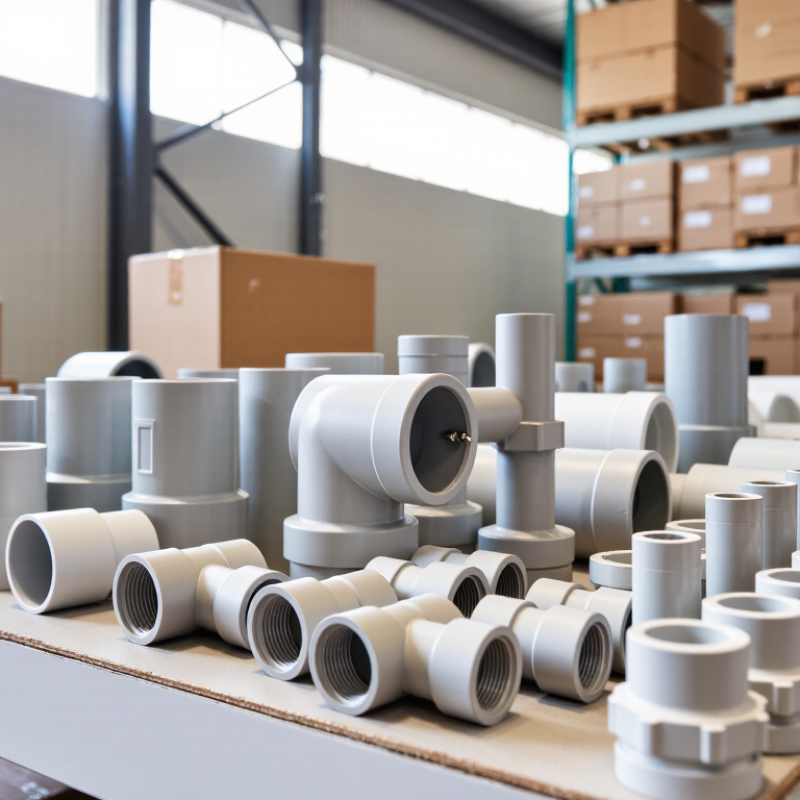
Table of Contents [Hide]
Understanding UPVC Fittings and Their Applications
UPVC, or unplasticized PVC, is a rigid thermoplastic used in pipework and fittings. Elbows redirect flow; tees branch it; reducers connect different pipe diameters. Small parts matter. A poorly matched fitting can restrict flow or create a leak point. PlasticsEurope’s Plastics—The Fast Facts 2023 estimated global plastics production at 400.3 million tonnes in 2022. That figure covers all plastics, not UPVC alone, so it provides context rather than a measure of fitting demand.
Common uses include cold-water distribution, building drainage, irrigation, and pressurized water networks. In buried systems, fittings help connect pipe runs around bends, junctions, and changes in size. ISO 1452-3 specifies requirements for PVC-U fittings in water supply and pressure drainage systems. Buyers should still check the intended service, pressure class, dimensions, and joining method; compliance with a standard does not guarantee suitability for every installation.
UPVC’s resistance to corrosion and relatively low weight can simplify handling, but installation details are easy to underestimate. Poorly prepared sockets, misaligned joints, or unsuitable support may cause trouble later. Exposure to sunlight and impact, especially in cold conditions, also deserve attention. Not always obvious. A fitting selected from a catalogue may look right, yet site conditions can tell another story. Check technical data and installation guidance before specifying it.
10 Best UPVC Fittings Manufacturers for Global Buyers - Understanding UPVC Fittings and Their Applications
A practical comparison of commonly specified UPVC (PVC-U) fittings, their typical uses, joining methods, and key points to verify when evaluating suppliers.
| Fitting Type | Typical Application | Common Connection | Buyer Checks |
|---|---|---|---|
| 90° Elbow | Changes the direction of a pipeline by 90 degrees in water distribution, irrigation, and building services. | Socket ends for solvent-cement joining; threaded versions are also available for some systems. | Confirm nominal size, pressure class, dimensions, and compatibility with the pipe system and applicable standard. |
| 45° Elbow | Provides a gradual directional change and is often used where a less abrupt turn is preferred. | Commonly supplied with solvent-cement socket ends. | Check the angle, end configuration, dimensional series, and intended service conditions. |
| Equal Tee | Creates a branch connection where the branch and run have the same nominal diameter. | Typically socket-ended; threaded branch options may be available in certain product ranges. | Verify all three connection sizes, pressure rating, and whether the branch configuration suits the piping layout. |
| Reducing Tee | Branches from a main line to a smaller-diameter pipe, commonly in distribution and irrigation networks. | Usually solvent-cement socket connections. | Confirm the run and branch size sequence, pressure class, and compatibility with the system’s pipe dimensions. |
| Reducer | Connects pipes of different diameters to transition between larger and smaller sections of a pipeline. | Socket-ended concentric or eccentric designs, depending on system requirements. | Check reducer type, inlet and outlet sizes, flow direction requirements, and applicable dimensional standard. |
| Straight Coupling | Joins two pipe ends of the same nominal size or makes a straight-line repair connection. | Commonly supplied as a double-socket fitting for solvent-cement joining. | Confirm socket depth, internal diameter, pressure class, and suitability for new installation or repair work. |
| Union | Provides a detachable connection that allows a section of pipe or equipment to be removed for maintenance. | Typically combines socket or threaded ends with a union nut and sealing element. | Review seal material, connection type, size, and access requirements for future disassembly. |
| Threaded Adapter | Connects a UPVC pipe system to compatible threaded valves, instruments, or other equipment. | Socket-to-male-thread or socket-to-female-thread configurations are common. | Check thread form and size, sealing method, pressure limits, and whether the mating component is compatible. |
| Flange Adapter | Creates a bolted connection to pumps, valves, tanks, or other flanged equipment. | UPVC pipe connection with a backing flange or integrated flange, used with a suitable gasket and bolts. | Verify flange drilling pattern, nominal diameter, pressure class, gasket dimensions, and alignment requirements. |
| End Cap | Closes the end of a pipeline for termination, testing, or future system extension. | Socket-ended caps are commonly solvent-cemented; threaded options may also be available. | Confirm end type, size, pressure rating, and whether the closure is intended to be permanent or removable. |
Specification note: Fitting dimensions, pressure ratings, temperature limits, and available connection styles vary by product series and market. Buyers should verify the relevant standard, test documentation, and compatibility with the complete pipe system before ordering.