
• Home
  • About
    • jute Bag

      Eco-Chic and Durable – Perfect for Sustainable Living.

      Cashew Nut Bag

      Sustainable jute bag for lasting cashew nut freshness

      Cocoa Bag

      Eco-friendly jute bag for rich cocoa flavor preservation

      Coffee Bag

      Elegant, durable jute bag to keep coffee beans fresh and eco-friendly

      Hazel Nut Bag

      Eco-conscious jute bag for hazelnut freshness and quality

      Shea Nut Bag

      Durable jute bag for fresh, organic shea nuts

      Tote Bag

      Stylish, eco-friendly jute tote for daily essentials

      Wheat Bag

      Sustainable jute bag for optimal wheat freshness

    • Jute Yarn

      Eco-Chic and Durable – Perfect for Sustainable Living.

      Jute Rope

      Sustainable jute bag for lasting cashew nut freshness

      Jute Fabrics

      Eco-friendly jute bag for rich cocoa flavor preservation

      Hessian cloth

      Sustainable Hessian cloth suppliers

  • Products
  • Export Country
  • Blog

7 Tips for Buying 3D Magnetic Toys in Bulk

Buying 3d Magnetic Toy sets in bulk can look simple on a spreadsheet. The real test comes when samples arrive: Do the pieces connect consistently? Are the edges smooth? Does the packaging protect every component during shipping? Small details matter when hundreds of boxes reach stores, schools, or distributors.

This guide covers seven practical checks, from magnet strength and material consistency to packaging, supplier communication, and sample testing. Ask for product specifications and inspect samples from the same production version you plan to order. A sample can feel sturdy, while a later batch may differ. That risk deserves attention.

A real expert quotation was not included with the source material, so this draft does not invent one. For a publishable version, add a verified quotation from a named toy-design or sourcing specialist. One useful principle to explore is: “A bulk order is only as dependable as the sample, specifications, and checks behind it.” Treat that as original wording, not an expert’s recorded statement.

Price matters. So does consistency. Check whether the pieces fit together without excessive force, whether the colors match across the set, and whether the instructions make sense to a first-time user. Keep written records of agreed specifications and sample results. It may feel overly cautious. It is not foolproof, either. But clear checks can make purchasing decisions more informed—and help prevent avoidable surprises when the cartons arrive.
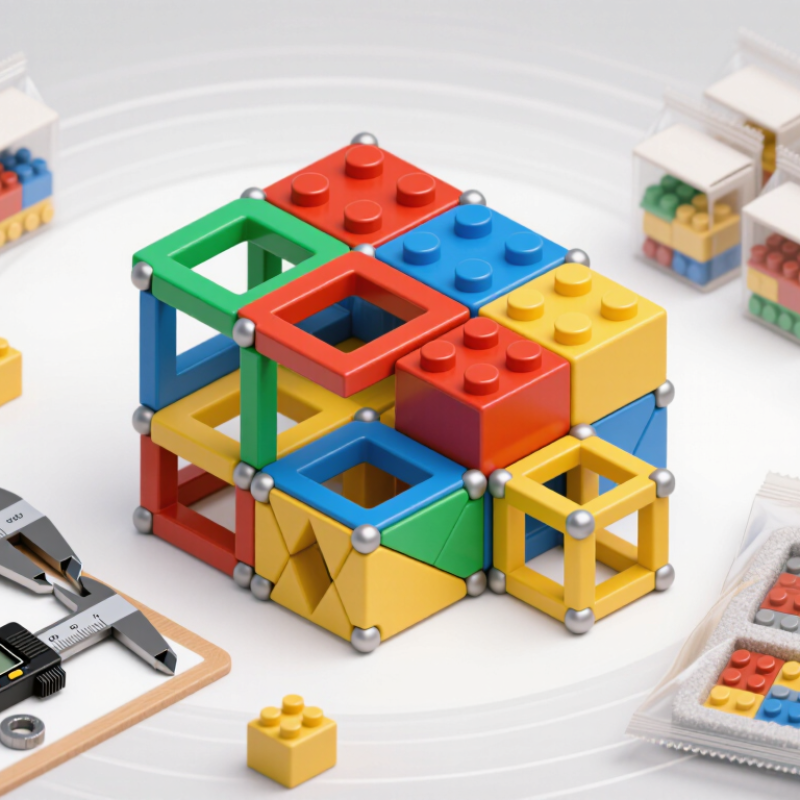
7 Tips for Buying 3D Magnetic Toys in Bulk

Define the Buyer, Age Grade, and Demand Before Setting Bulk Quantities

Before setting a bulk quantity, define the buyer. A school supplier, gift shop, and online seller face different budgets, shelf space, and reorder speeds. A gift shop may favor compact sets for occasional purchases. A classroom buyer may need repeatable kits for group activities. Don’t treat these channels alike. Circana’s 2023 U.S. toy industry review reported an 8% sales decline and a 7% drop in units sold. That broad market result is a caution, not a forecast for 3D magnetic toys. Check local sell-through before committing to a large order.

Age grade shapes both demand and product suitability. The U.S. Consumer Product Safety Commission’s Age Determination Guidelines advise considering children’s abilities and intended users when assessing age suitability. Use the product’s verified age grading, then estimate demand within that group. Parents shopping for younger children may prioritize simple builds and easy-to-hold pieces; older children may want more complex structures. Details matter. Ask buyers about expected weekly sales, peak seasons, and replenishment time. A small trial order can reveal whether a bright display actually converts into sales. It may not. Review results by age group and sales channel, then adjust the next quantity instead of relying on one optimistic estimate.

Compare Magnet Strength, Build Quality, and ASTM F963 Test Reports

When sourcing 3D magnetic toys in bulk, compare magnet strength by asking for clear specifications and consistent measurements. Stronger magnets are not automatically better; the pieces should connect firmly without making assembly frustrating. Check whether attraction feels similar across several samples, not just the best-looking unit. Small differences matter.

Inspect build quality in person when possible. Look closely at seams, rounded edges, surface coatings, and connector fit. Pieces should join without wobbling, and finishes should not peel after ordinary handling. Request samples from more than one production batch if the order is large. A neat sample can still hide uneven production. No checklist catches everything.

Ask for an ASTM F963 test report that matches the exact toy model and materials being purchased. Check the report date, tested components, and laboratory details, then confirm that the supplier can link the report to the goods offered. Reports describe tested samples; they do not prove every later batch is identical. That distinction is easy to overlook. Keep batch records and consider independent checks on delivered stock, especially when colors, materials, or magnet assemblies change.

Verify U.S. Limits: Lead ≤100 ppm and Restricted Phthalates ≤0.1%

When buying 3D magnetic toys in bulk, check safety documents before comparing prices. For children’s products covered by U.S. rules, lead in accessible components must not exceed 100 ppm. Certain restricted phthalates must not exceed 0.1% in applicable accessible plasticized parts. The limits do not automatically describe every material or product, so ask which components were tested and which requirements apply. Small details matter.

Tip 1: Request current test reports from an accredited laboratory. Match the report’s product description, model, and materials to the toys you plan to order. A generic certificate may not cover a new color or revised plastic blend. Tip 2: Ask the supplier to identify tested parts, such as the magnetic housing, flexible connectors, and painted pieces. Keep batch records and check that production materials have not changed.

Tip 3: Confirm the report measures lead and each restricted phthalate separately, with results shown against the relevant limits. Review dates and sample descriptions; a neat-looking PDF is not proof by itself. If anything is unclear, request clarification before placing a large order. Testing reduces uncertainty, but it cannot guarantee every unit is identical. That part is easy to overlook.

7 Tips for Buying 3D Magnetic Toys in Bulk — Verify U.S. Limits: Lead ≤100 ppm and Restricted Phthalates ≤0.1%
Tip What to Verify U.S. Requirement or Reference Evidence to Request Before Ordering
1. Confirm the product’s age grading and regulatory scope Check the intended age group, packaging, instructions, and whether the item is classified as a children’s toy. Confirm which toy and magnet safety requirements apply to the specific design. Toys intended for children under 14 are generally subject to applicable federal toy requirements, including ASTM F963 as incorporated by 16 CFR Part 1250. Magnet-product requirements may also depend on product classification. Written age-grading rationale, product description, intended-use information, and a compliance checklist identifying applicable rules.
2. Check lead in accessible components Ask for testing of accessible substrate materials and relevant components, such as plastic pieces, metal parts, and coatings. Ensure the tested sample matches the production item. For children’s products, lead in an accessible component part must generally not exceed 100 ppm, subject to applicable statutory exceptions. Lead in paint and similar surface coatings is limited to 90 ppm under a separate rule. Test reports identifying the material, component, test method, result, sample description, and date. Reference: CPSC lead requirements.
3. Verify restricted phthalates by individual substance Confirm that each applicable plasticized component has been evaluated; a general statement that a product is “phthalate-free” is not a substitute for substance-specific results. For covered children’s toys and child-care articles, each of the eight restricted phthalates is limited to 0.1% (1,000 ppm) in accessible component parts: DEHP, DBP, BBP, DINP, DIDP, DnHP, DCHP, and DIBP. A test report listing each restricted phthalate and its result for relevant materials. Reference: CPSC phthalates guidance.
4. Assess magnet security and ingestion hazards Inspect whether magnets can detach, break, or become accessible during foreseeable use and abuse. Ask how the product’s magnet design and classification were evaluated. Magnet safety requirements depend on the product and its regulatory classification. Applicable toy requirements and, where relevant, 16 CFR Part 1262 should be reviewed. Product-specific magnet hazard assessment, applicable test reports, and design details showing how magnets are retained. Do not rely only on a supplier’s generic certificate.
5. Request testing from an appropriately accredited laboratory For children’s products subject to CPSC-enforced requirements, verify that required third-party testing was performed by a laboratory accepted by the CPSC for the relevant rules. Children’s products subject to applicable rules generally require testing by a CPSC-accepted third-party laboratory. See the CPSC laboratory search. Laboratory name, CPSC acceptance scope, report number, tested model or SKU, tested components, and report date.
6. Obtain the required Children’s Product Certificate For each covered children’s product, confirm that the responsible domestic manufacturer or importer has issued a certificate based on applicable testing and identifies the product and rules covered. A Children’s Product Certificate (CPC) is required for children’s products subject to applicable federal children’s product safety rules. A test report and a CPC serve different purposes. A CPC listing the product, each applicable rule, the certifying party, contact details, test location, and test date. Reference: CPSC CPC guidance.
7. Control production lots and shipment records Before placing a bulk order, agree on model identification, material specifications, change control, lot traceability, inspection sampling, and what happens if a production change affects compliance. Children’s products generally require tracking information on the product and packaging to the extent practicable. A report for one sample does not by itself establish that every later production lot is identical. Approved sample, bill of materials, lot or date-code plan, packaging artwork, inspection records, and written notification requirements for changes to magnets, plastics, coatings, or suppliers.

Calculate Landed Cost, Minimum Order Quantity, and Reorder Lead Time

For 3D magnetic toys, compare landed cost per sellable unit, not just the factory price. Add packaging, freight, insurance, customs duties, brokerage, and delivery to your warehouse. Divide the total by units that pass inspection, not merely units shipped. A slightly larger box can raise freight costs quickly. Small detail. It matters. Ask suppliers for carton dimensions, packed weight, and a written quote with clear shipping terms. The World Bank’s 2023 Logistics Performance Index scored Singapore 4.3 out of 5, illustrating how logistics performance differs by market. Treat route and clearance estimates as variables, not promises.

MOQ ties up cash before you know how quickly each color or set will sell. Request pricing at several quantities, then compare unit savings with storage costs and expected sell-through. For reorders, count production, inspection, transit, customs clearance, and warehouse receiving. UNCTAD’s Review of Maritime Transport 2024 notes that shipping carries over 80% of world trade by volume, so port delays can affect replenishment plans. Set a reorder point using average weekly sales during the full lead time, plus a modest buffer. I would still revisit that buffer after the first shipment; forecasts can look precise and be wrong. Keep a dated record of quoted and actual lead times.

Approve Samples, Traceability, and Batch Inspections Before Shipment

Bulk orders amplify small defects, so approve a physical sample before production starts. Record its dimensions, color, surface finish, magnet placement, and packaging details. Ask the supplier to sign and date the approved reference sample, then keep one sealed. A photo alone may miss a loose component or a rough edge.

Trace each shipment to production details, including lot codes, production dates, material batches, and inspection records. For magnetic parts, request documented checks for secure enclosure and consistent performance. The U.S. Consumer Product Safety Commission’s 2023 toy-related injury report estimated 231,700 toy-related emergency-department visits. That figure covers toys broadly, not magnetic toys specifically, but it shows why careful quality controls matter.

Before shipment, inspect samples from each production batch using a written plan. ISO 2859-1 describes acceptance sampling by lot size and inspection level; agree on suitable criteria with a qualified quality professional. Check dimensions with calibrated gauges, inspect coatings and seams, and test packaging against the approved sample. Keep dated photos and inspection results tied to each lot. Small misses happen. Sampling cannot guarantee every unit is defect-free, so document exceptions and require corrective action before release.

Shopping Basket