
• Home
  • About
    • jute Bag

      Eco-Chic and Durable – Perfect for Sustainable Living.

      Cashew Nut Bag

      Sustainable jute bag for lasting cashew nut freshness

      Cocoa Bag

      Eco-friendly jute bag for rich cocoa flavor preservation

      Coffee Bag

      Elegant, durable jute bag to keep coffee beans fresh and eco-friendly

      Hazel Nut Bag

      Eco-conscious jute bag for hazelnut freshness and quality

      Shea Nut Bag

      Durable jute bag for fresh, organic shea nuts

      Tote Bag

      Stylish, eco-friendly jute tote for daily essentials

      Wheat Bag

      Sustainable jute bag for optimal wheat freshness

    • Jute Yarn

      Eco-Chic and Durable – Perfect for Sustainable Living.

      Jute Rope

      Sustainable jute bag for lasting cashew nut freshness

      Jute Fabrics

      Eco-friendly jute bag for rich cocoa flavor preservation

      Hessian cloth

      Sustainable Hessian cloth suppliers

  • Products
  • Export Country
  • Blog

Top Inflatable Bubble Tent Manufacturers in China

China’s inflatable-product sector offers buyers a wide range of bubble tent designs, sizes, and customization options. Yet a polished product photo tells only part of the story. Inflatable Bubble Tents must handle changing weather, repeated inflation, and the daily wear of real use. Seams matter. So do clear windows, zipper quality, ventilation, and anchoring points.

Quality expert W. Edwards Deming is often associated with the principle, “Quality is everyone’s responsibility.” Applied to bubble tents, that means looking beyond the sales team’s promises. Ask how materials are specified, how seams are checked, and whether finished units undergo leak testing. A dependable manufacturer should explain these details plainly. Vague answers deserve a second look.

This guide explores leading manufacturers in China and the factors that help distinguish them. It considers product range, material choices, customization, production experience, communication, and after-sales support. Buyers should also request current specifications and confirm that samples match the proposed production model. Small details matter: a vent placed too high, a cloudy viewing panel, or a hard-to-repair valve can change the user experience. No supplier is flawless. And a factory visit or sample review cannot reveal everything. Still, careful questions make comparison more grounded—and less dependent on attractive catalogs.
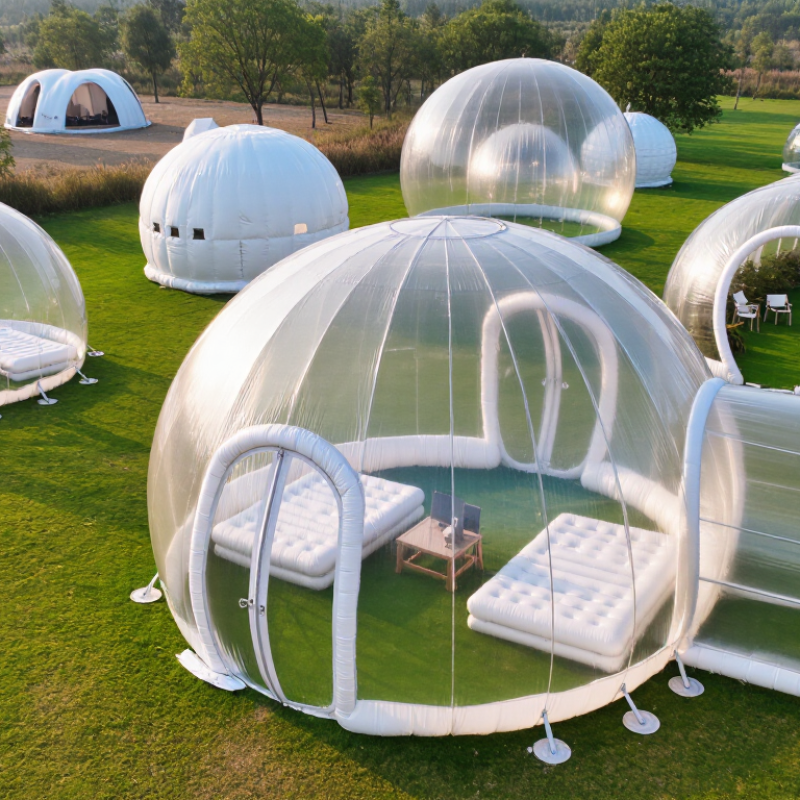
Top Inflatable Bubble Tent Manufacturers in China

What Inflatable Bubble Tents Are and How They Work

Inflatable bubble tents are temporary shelters built from flexible, transparent or partly transparent panels. Unlike pole tents, many designs use air-filled beams to hold their shape. A low-noise electric blower may keep those beams pressurized, while sealed seams help limit air loss. Some models use separate chambers, so a small leak does not always collapse the whole structure. Design details vary, and buyers should check the manufacturer’s setup and care instructions.

Setup usually starts with laying the tent on a clean, level surface and securing its anchor points. The blower then inflates the structural tubes; the clear enclosure itself may remain unpressurized. Check the valves and seams. A properly fitted door and ventilation openings help manage airflow, but condensation can still form when warm breath meets cool panels. That detail is easy to underestimate. In practice, occupants may need to adjust ventilation as temperatures change, while keeping the blower’s power supply dry and protected. Transparent walls offer a broad view of the surroundings, yet they provide limited privacy and can heat up in direct sun. Before choosing a tent, compare its dimensions, material thickness, anchoring method, and stated operating conditions. Even careful setup has limits, especially in gusty weather.

China’s Inflatable Bubble Tent Manufacturing Landscape

China’s Inflatable Bubble Tent Manufacturing Landscape

China’s inflatable bubble tent manufacturing landscape brings together material suppliers, product designers, and assembly teams. Production often combines clear PVC or TPU panels, reinforced seams, air blowers, and protective floor sections. The exact mix depends on the intended use and price range. Details matter. A carefully finished seam can affect both appearance and air retention.

Manufacturing quality is not judged by photographs alone. Buyers can ask how panels are joined, how seams are checked, and whether replacement parts are available. Sample inspections may reveal uneven stitching, cloudy film, or awkward door placement. These small issues matter during setup. Specifications should also state dimensions, packed weight, blower requirements, ventilation features, and care instructions. Ask for written test records, but check what each test actually covers. A single pressure check does not prove long-term durability.

The landscape is varied, and product descriptions do not always make comparisons easy. One uncertainty is how consistently materials perform after repeated folding and exposure to sunlight. Request clear material details and sample units when practical. A realistic assessment should consider transport, cleaning, and repair—not just the dome’s appearance. Even a well-made tent can disappoint if its site, weather, or maintenance needs are misunderstood.

Top Inflatable Bubble Tent Manufacturers in China - China’s Inflatable Bubble Tent Manufacturing Landscape

Manufacturing Dimension Typical Market Offering Production Considerations Buyer Checks
Transparent materials Clear PVC is commonly used for transparent panels; TPU is another option in some product designs. Fabric components may use coated textiles. Material choice affects clarity, flexibility, weight, cold-weather behavior, and cleaning requirements. Request material specifications, care instructions, and samples representative of the finished product.
Structure and layout Market designs include dome-like enclosures and models combining transparent panels with an opaque base, vestibule, or support structure. Pattern design and panel joining need to account for access points, ventilation, and the intended installation method. Confirm assembled dimensions, usable floor area, door placement, and anchoring arrangements.
Joining and assembly Production may involve heat or high-frequency welding for compatible plastic seams, alongside sewing for fabric sections and accessories. The appropriate joining method depends on the material, panel geometry, and whether the design is air-supported or uses a separate frame. Ask how seams are inspected and whether a completed unit is checked before packing.
Air supply and ventilation Some air-supported designs use a blower to maintain pressure; other configurations may use different support systems. Ventilation provisions vary by design. Blower requirements, air inlets, ventilation, and access closures should be designed as a coordinated system. Verify the supplied equipment, electrical requirements, operating instructions, and ventilation plan.
Customization and OEM production Custom dimensions, layouts, colors, access doors, flooring, printed elements, and accessory packages may be available, subject to the design and order requirements. Changes to dimensions or panel layouts can affect pattern development, material use, tooling, and production scheduling. Approve drawings, material details, and a written specification before production begins.
Quality checks Relevant checks can include visual inspection, dimensional checks, seam review, and leakage or inflation checks where applicable. Inspection procedures should match the product construction and intended use; methods and acceptance criteria can differ between suppliers. Request the inspection checklist, test conditions, and any applicable material or product reports.
Typical applications Products are marketed for uses such as glamping, temporary accommodation, events, displays, and recreational settings. Weather exposure, occupancy, ground conditions, and duration of use influence the required specification. Match the design to the site and intended use; do not assume every model is suitable for every weather condition.
Export and documentation Export-oriented suppliers may offer export packing and product documentation, with details depending on the order and destination market. Packaging, shipping dimensions, customs paperwork, and destination requirements should be agreed before shipment. Confirm packing details, included accessories, delivery terms, and any destination-specific compliance requirements.

Note: This is a general overview of product and manufacturing practices found in the market. Materials, processes, specifications, and available services vary by supplier and model; verify details for each order.

Leading Inflatable Bubble Tent Manufacturers in China

Leading inflatable bubble tent manufacturers in China serve a growing outdoor market, but demand data should be read carefully. The Outdoor Industry Association’s 2024 Outdoor Participation Trends Report counted 175.8 million U.S. participants in outdoor recreation during 2023. That figure covers many activities, not bubble-tent buyers specifically. Grand View Research estimated the global camping tent market at USD 3.45 billion in 2022, with projected growth through 2030. These broader indicators suggest opportunity, not guaranteed sales.

For buyers, manufacturing capability matters more than a polished showroom dome. Ask for material specifications, seam-construction details, ventilation layouts, and documented checks on anchoring points. Request a sample and inspect it after repeated inflation; look closely at zipper alignment and condensation around clear panels. Small flaws show up fast. Even a good prototype can mislead. Production consistency needs separate verification. A qualified supplier should explain how it controls film thickness, weld strength, and packing procedures across batches. China has extensive manufacturing capacity, yet supplier quality varies, and product categories are not always defined consistently. Compare written test records with physical samples before placing a large order.

Materials, Production Processes, and Quality Standards

Material choice shapes an inflatable bubble tent’s clarity, comfort, and service life. Manufacturers commonly use transparent PVC or TPU films, selected for flexibility, weldability, and resistance to outdoor conditions. A clear panel should remain evenly transparent, without cloudy patches or visible inclusions. Thickness matters, but it is not a guarantee of durability. A poorly formulated thick film can still crease or weaken in cold weather. Details matter.

Production starts with cutting film panels to controlled templates. Workers align edges before heat or high-frequency welding, since uneven seams can cause leaks under pressure. Door zippers, ventilation openings, and blower connections need reinforced attachment points. After assembly, factories should inflate each unit and check for pressure loss, seam separation, and faulty fittings. Small defects can hide near corners.

Reliable quality checks go beyond a quick visual inspection. Buyers can request material specifications, batch traceability, seam-strength records, and documented air-retention tests. Testing should reflect the tent’s intended climate and use, including exposure to sunlight and temperature changes. A factory should also explain how it checks blower compatibility and repairs weld defects. Certification claims need supporting documents, not just a label. One limitation remains: test results from a sample do not prove every production unit will perform identically. Random checks across finished batches provide a more realistic picture.

How to Evaluate and Select a Chinese Manufacturer

When evaluating inflatable bubble tent manufacturers in China, look beyond product photos and polished factory videos. Request a production sample and inspect the seams, transparent panels, zippers, air inlets, and anchor points. Ask what material is used, how its thickness is measured, and whether test reports match the exact model you plan to order. A certificate for a different material or product is not enough. Ask for proof.

Check how quality control works on the production line. Request photos or video of pressure checks, seam inspections, and packing procedures, then compare these with a sample unit. Small details matter. Confirm blower capacity, spare-part availability, packaging dimensions, and realistic production lead times in writing. A clear specification sheet helps prevent misunderstandings, though it cannot catch every issue.

Communication is part of the evaluation. Notice whether the supplier answers technical questions directly and flags limitations instead of promising everything. Ask about previous export experience, but verify claims with references or a video call from the workshop. Even a strong sample can hide inconsistent batch quality. I would not rely on one inspection alone; arrange an agreed pre-shipment check when the order is significant. And leave room for surprises. A delayed reply or unclear warranty term may deserve a second look before payment.

How to Evaluate an Inflatable Bubble Tent Manufacturer

Suggested evaluation weights for comparing suppliers. These are planning guidelines, not survey results or ratings of specific manufacturers.

Prioritize documented product safety and build quality, then verify customization, production capacity, communication, and after-sales support. Request test reports, material specifications, samples, and written production details before making a decision.

Shopping Basket