
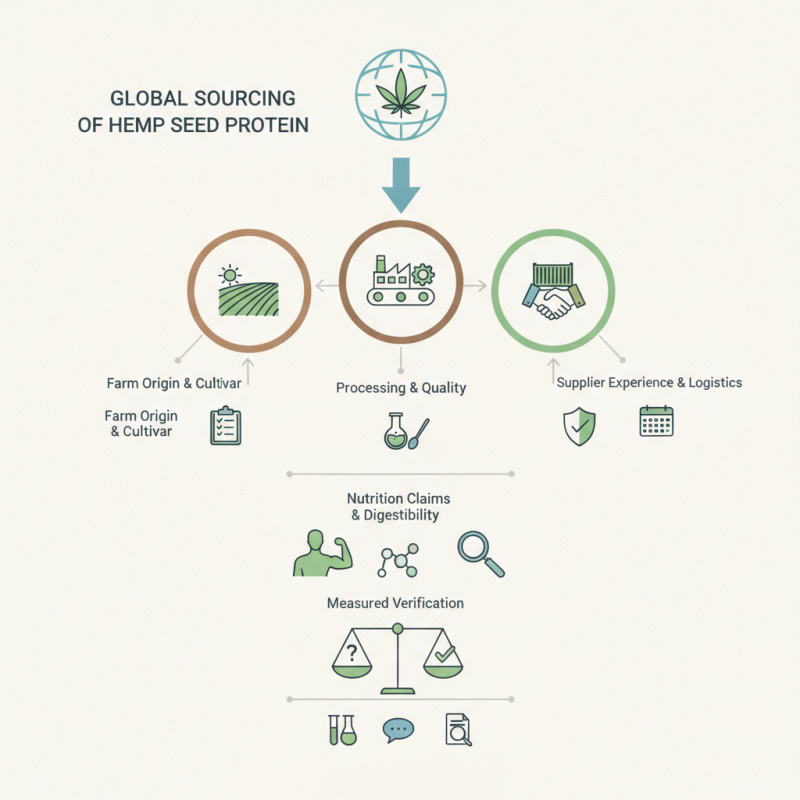
Choosing Hemp Seed Protein for global sourcing requires more than comparing protein percentages. Buyers need evidence from the farm, the processing line, and the finished lot. Richard Rose, a long-time hemp-food educator, observed, “Hemp is one of the most versatile and sustainable crops on earth.” That promise still needs verification.
Start with origin and cultivar records. Ask whether farmers use documented, compliant hemp varieties. Request batch-specific certificates of analysis. Check protein content, moisture, microbial counts, heavy metals, pesticides, and allergen controls. Do not accept generic laboratory summaries. A clear lot number should connect the farm, mill, warehouse, and shipment.
Processing also shapes purchasing decisions. Cold milling may protect flavor, while finer grinding improves dispersion in smoothies and bakery mixes. However, performance can change between harvests. Request sample bags from different lots. Test them in the intended recipe. A powder that mixes smoothly in water may feel gritty in a protein bar.
Supplier experience matters. Look for HACCP or equivalent food-safety systems, transparent traceability, stable export documentation, and realistic lead times. Confirm packaging strength before ocean transport. A torn liner can ruin an otherwise compliant shipment.
Nutrition claims require care. Hemp Seed Protein naturally provides plant protein and may contain useful minerals, but the exact profile depends on processing and testing. Compare amino-acid data, not marketing language. Digestibility can be overlooked.
There is no perfect supplier. I would record weaknesses openly. One vendor may offer excellent documentation but inconsistent flavor. Another may provide attractive pricing but limited harvest history. Global sourcing rewards measured verification, not optimistic assumptions. Test, question, and review every shipment.
When sourcing hemp seed protein globally, grade selection should begin with the intended use, not a supplier’s headline claim. Hemp seed flour usually contains about 25–35% protein, depending on pressing, milling, and moisture. It retains more fiber, minerals, and natural flavor. In a bakery trial, it may create a beige crumb and a slightly nutty finish. That can be useful, or inconvenient. Ask whether protein percentages are reported on an as-is or dry-matter basis. This detail changes comparisons.
Higher-protein concentrates often sit between flour and isolate, with lower fiber and smoother dispersibility. An isolate near 80% protein suits shakes, nutrition bars, and formulations requiring greater protein density. Yet purity does not guarantee better performance. Solubility, particle size, taste, and water absorption should be tested in the final recipe. A 25-kilogram sample can reveal more than a polished specification sheet. It can also expose problems.
For global purchasing, request a recent certificate of analysis, batch traceability, allergen statement, microbiological results, and contaminant testing. Confirm the analytical method, origin, harvest date, packaging conditions, and storage temperature. Compare at least two production lots before approving a contract. I would also check how the powder behaves after shipping through humidity changes. A supplier may provide complete documents, but incomplete questions remain the buyer’s responsibility. That is the uncomfortable part. Grade labels become meaningful only when measurements and application trials agree.

Hemp seed protein can provide all nine essential amino acids, including leucine, valine, and lysine. However, its lysine level is usually lower than its sulfur-containing amino acids. This matters when evaluating protein quality for sports nutrition, meal replacement, or fortified foods. A supplier may advertise “complete protein,” but that phrase does not mean every amino acid appears in equal amounts. In sourcing work, I review the amino-acid profile per 100 grams of protein, not merely per serving.
Ask for recent laboratory reports showing all nine EAAs, protein percentage, moisture, and testing methods. Compare lysine values between lots, because processing and crop conditions can create noticeable variation. Digestibility also deserves attention. A strong amino-acid profile may still perform differently after milling, heating, or blending. I would not pretend one report proves permanent quality. Repeated testing builds more confidence.
Tips: Check whether the report uses protein-normalized data. Confirm that lysine is measured, not estimated. Request samples from different production batches. Consider blending hemp protein with a lysine-rich plant protein when the final formula requires better balance. Keep the blend’s taste and texture in view. Numbers alone can mislead. A slightly lower lysine result may be acceptable for one product, but unsuitable for another.
How to Choose Hemp Seed Protein for Global Sourcing
Audit COAs for Moisture, Microbes, Heavy Metals, and Protein Content
A certificate of analysis, or COA, should identify the exact product lot. Check the production date, sample date, laboratory name, and test methods. A missing lot number is a warning sign. Ask whether the laboratory used validated methods and maintained independent quality controls. In practice, a polished PDF can still hide weak evidence.
Moisture results matter because excess water can encourage microbial growth and shorten shelf life. Compare the reported value with your product specification, not only the supplier’s target. Review total plate count, yeast, mold, and relevant pathogens. The report should show units, detection limits, and clear pass or fail criteria. “Not detected” is incomplete without a detection limit.
Heavy metal testing should cover lead, cadmium, arsenic, and mercury. Hemp plants can absorb contaminants from soil, so sampling location deserves attention. Protein content also needs careful review. Confirm whether the value is reported on an as-is or dry basis. Check the calculation method and compare it with the nutrition specification. Protein numbers may look strong after moisture adjustment. That can create confusion. Keep original reports, request recent lot-specific testing, and record every unresolved question before approving global supply.
How to Choose Hemp Seed Protein for Global Sourcing
Hemp seed protein can look compliant on paper yet fail a buyer’s receiving test. Global sourcing needs evidence, not polished claims. The WHO estimates that contaminated food causes 600 million illnesses and 420,000 deaths annually worldwide. That figure makes verification a commercial duty, not paperwork.
Request a current non-GMO declaration, production-flow statement, and identity-preservation records. Organic status must match the exporting country, processing site, and transaction documents. A farm certificate alone may not cover protein processing. Check the certification scope carefully. HACCP records should identify biological, chemical, and physical hazards, including allergen controls, sanitation logs, and metal-detector checks. Ask for recent laboratory reports, not generic templates.
Use laboratories operating under ISO/IEC 17025 accreditation where possible. Test results should cover microbiology, heavy metals, pesticide residues, mycotoxins, and relevant contaminant limits. Codex Alimentarius provides international food-safety principles and reference limits, but Codex does not issue product certificates. Compare those limits with the destination market’s rules. WHO’s global food-safety estimates come from its burden-of-disease report, not a hemp-specific study; that distinction matters. One weak point remains: no certificate covers every shipment. Keep sealed retain samples, verify lot numbers, and review unexpected results before approving repeat orders.
How to Choose Hemp Seed Protein for Global Sourcing
A reliable supplier should show where each hemp seed lot originated. Ask for farm-region records, harvest dates, processing locations, and lot-specific certificates of analysis. Traceability should continue from seed intake to sealed export cartons. Check protein content, moisture, microbiological results, allergens, and heavy metals. Generic documents are not enough.
MOQ can shape your entire purchasing plan. A low MOQ may suit product testing, but its price can be higher. A large MOQ may reduce unit cost while creating storage pressure. Request samples from the same production line used for commercial orders. Confirm whether the quoted MOQ applies per flavor, package size, or shipment. Small details matter.
Lead time should include production, testing, documentation, and port handling. Ask for a realistic range, not a perfect promise. Incoterms also need careful comparison. Under FOB, the buyer usually manages main ocean freight. Under CIF, the seller arranges freight and insurance to the named port, but destination charges may remain. Clarify the exact named place, transfer of risk, customs responsibilities, and required export documents. One overlooked charge can erase the expected savings. A spreadsheet can look complete and still hide weak assumptions. Recheck them before signing.
Anonymous sourcing profiles for comparing commercial readiness, documentation quality, logistics flexibility, and quality-control requirements.
| Anonymous Supplier Profile | Origin & Traceability | Typical Protein Content | Minimum Order Quantity (MOQ) | Standard Lead Time | Available Incoterms | Quality & Compliance Documentation | Testing & Batch Controls | Packaging Format | Sourcing Assessment |
|---|---|---|---|---|---|---|---|---|---|
| Profile A Established export processor | Farm and lot identification available from approved growers to finished powder. Traceability: 100% batch-linked records | 45–50% protein by dry basis, subject to the agreed specification | 500 kg for standard production; lower quantities may require a surcharge | 4–6 weeks after purchase-order confirmation and artwork approval | FOB, FCA, CIF, CFR | Certificate of Analysis (CoA), allergen statement, GMO statement, HACCP-based food-safety documentation, and organic documents when applicable | Microbiology, moisture, protein, heavy metals, pesticide-residue screening, and lot retention samples | 20–25 kg multi-wall bags with food-grade inner liner | Strong for annual programs |
| Profile B Flexible regional processor | Country and processing-site records available; farm-level information provided on request. Traceability: lot-based | 40–45% protein by dry basis, depending on seed variety and milling process | 100–250 kg per shipment | 3–5 weeks for regular items; 6–8 weeks during harvest or peak demand | EXW, FCA, FOB, CIF | CoA, specification sheet, allergen declaration, food-contact packaging statement, and standard food-safety questionnaire | Routine microbiology and proximate analysis; pesticide and heavy-metal testing available as an additional service | 10 kg or 20 kg bags; palletized export cartons available | Good for pilot-to-scale sourcing |
| Profile C Small-batch specialty processor | Processing lot and harvest region identified; complete grower-level records may not be included in every shipment. Traceability: partial farm-to-lot | 35–42% protein by dry basis | 25–100 kg per order | 2–4 weeks for available stock; 8–10 weeks for made-to-order material | EXW, FCA | CoA and product specification normally available; third-party certification depends on the production lot | Basic microbiology, moisture, and protein testing; expanded contaminant panels require buyer approval | 5 kg or 10 kg lined bags; bulk export packaging may require a custom order | Useful for sampling and market testing |
| Profile D Large-volume industrial processor | Documented supplier-approval system and internal lot coding; electronic traceability records available for commercial contracts. Traceability: batch and shipment linked | 50–55% protein by dry basis for higher-protein grades; specification must be confirmed before purchase | 1,000–2,000 kg per order | 6–10 weeks, including production scheduling and export documentation | FCA, FOB, CFR, CIF | CoA, HACCP or equivalent food-safety system, technical data sheet, allergen statement, GMO statement, and export documents | In-house testing supported by periodic independent laboratory verification; contaminant testing aligned with destination-market requirements | 20 kg or 25 kg bags; big-bag supply may be available for contract volumes | Best for predictable high-volume demand |
| Profile E Distributor with multi-origin supply | Traceability is maintained by supplier lot and warehouse records; origin can vary unless fixed in the contract. Traceability: distributor-to-lot | 35–50% protein by dry basis, depending on the selected origin and grade | One pallet, commonly 400–600 kg | 1–3 weeks from regional stock; 6–12 weeks for replenishment | EXW, FCA, DAP, CIF | CoA, specification sheet, safety data where required, allergen statement, and available certification copies | Usually relies on the processor’s CoA; buyer should request independent verification for the first shipment | 10 kg or 20 kg bags; warehouse repacking may be available | Convenient, but verify origin consistency |
| Profile F New export entrant | Country of origin and processing location stated; farm-level mapping and historical records are still developing. Traceability: shipment-based | 35–45% protein by dry basis | 200–500 kg per order | 5–8 weeks; buffer time is recommended for first shipments | EXW, FOB; destination delivery subject to separate logistics arrangement | CoA and basic product specification available; certification and audit records should be reviewed before approval | Standard microbiology and proximate analysis; confirm pesticide, heavy-metal, and foreign-material controls in writing | 20 kg bags with food-grade liner; export pallet standard should be confirmed | Requires enhanced due diligence |
We are the most reliable and proficient jute goods manufacturer & supplier that helps businesses or individuals with various exportable agricultural commodities biz and jute goods by shipping them worldwide. Our right-time service ensures that whatever color and size of jute product you need, we can make it happen anytime and anywhere! Let’s keep our earth safer to live in!
Important link
Address
Bangladesh Address:
Fair Plaza (9th Floor), Plot : 3C, Section : 01, Mirpur, Dhaka:1216
UK Office:
242 Manor Road, Droylsden, Manchester, M43 6JD, United Kingdom.
Let's Talk
We are the most reliable and proficient jute goods manufacturer & supplier that helps businesses or individuals with various exportable agricultural commodities biz and jute goods by shipping them worldwide. Our right-time service ensures that whatever color and size of jute product you need, we can make it happen anytime and anywhere! Let’s keep our earth safer to live in!
Bangladesh Address:
Fair Plaza (9th Floor), Plot : 3C, Section : 01, Mirpur, Dhaka:1216
UK Office:
242 Manor Road, Droylsden, Manchester, M43 6JD, United Kingdom.