
Choosing the right Makeup Eyeshadow can shape how customers recognize, use, and remember your brand. A popular color is not automatically the right product. Begin with your intended customer, price point, and desired finish: a soft matte for everyday wear needs different performance from a reflective shimmer for evening looks. Looks matter. So does how the formula feels on a fingertip, blends across the lid, and appears in daylight.
Compare practical details before committing to a palette. Check pigment payoff, fallout, blendability, wear, and how consistently shades perform across different skin tones. Ask suppliers for ingredient information, product specifications, and relevant quality or safety documentation; verify claims rather than relying on sales language. Test samples in real routines, using clean tools and a range of lighting. Test it. Then record what works and what does not. A shade may photograph beautifully yet turn patchy after several hours, or a compact may feel polished but be awkward to open.
Brand fit also includes packaging, naming, shade balance, and a clear point of difference. Review customer feedback and competitor offerings, but do not let trend reports make every decision. They can miss what your actual buyers want. This process is rarely perfect; early tests may expose gaps in the palette or a formula that needs revision. Treat those findings as useful evidence, not failure. A thoughtful choice balances visual appeal with consistent performance, dependable sourcing, and honest product descriptions. That gives your brand a stronger foundation for launching eyeshadow customers can enjoy and trust.
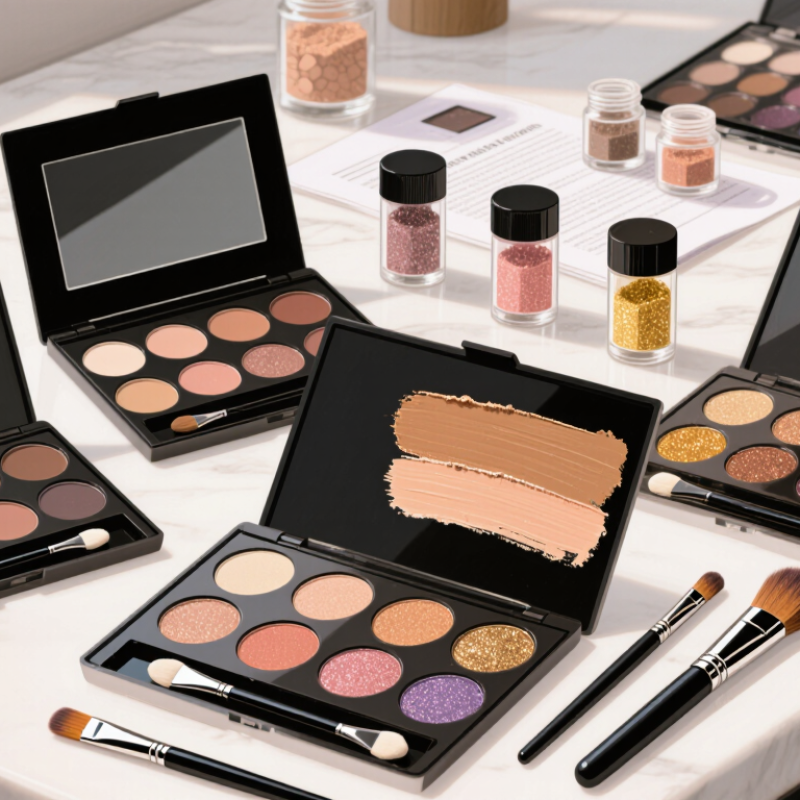
Choose the audience before choosing the shades. A beginner buying a workday palette may value blendable neutrals and clear shade labels; an experienced makeup user may seek strong pigment and unusual finishes. Consider skin tones, application habits, price range, and where customers will wear the product. McKinsey’s 2023 beauty-market report projected roughly 6% annual growth through 2027, but market growth alone does not prove demand for your palette. Circana reported that U.S. prestige makeup sales rose 9% in 2023. That figure describes sales, not every shopper’s preferences. Small tests matter.
Positioning should guide specific product choices. An everyday, accessible palette might need a compact case, reliable mattes, and a few shimmer shades that work in natural light. A premium, artist-focused product could prioritize intense payoff, layered finishes, and sturdy packaging for frequent use. Set measurable goals: target price, number of shades, wear time, and acceptable returns or complaints. Then test prototypes with people who match your intended audience, checking blendability, fallout, and whether shade names are easy to understand. I would not assume one successful focus group represents everyone; that shortcut is tempting, and often wrong. Use feedback alongside sales data, and revise the formula or shade mix when evidence points to a mismatch.

Start by matching format to how customers apply shadow. Pressed powder is familiar, portable, and easy to build with a brush; however, hard-pressed pans can feel less blendable. Loose pigments offer intense payoff, but may scatter onto cheeks and need careful packaging. Creams and sticks travel well and suit quick fingertip application. They can crease on oily lids, depending on formula and prep. Test real use.
Texture changes both appearance and handling. Matte shades help define the crease, while satin finishes catch soft light without obvious sparkle. Shimmer can brighten a lid, whereas chunky glitter may emphasize texture and create fallout. These are tendencies, not guarantees. Particle size, binders, and pigment load all matter. Compare swatches under daylight and indoor lighting, then check blending, fallout, and wear after several hours. One swatch is not enough.
Formula type deserves equal attention. Powder formulas often layer easily; cream formulas may feel richer and need controlled dosing. For a cohesive range, consider a pressed neutral palette, a few creams, and finishes that work across skin tones. Ask suppliers for ingredient documentation, stability data, and batch consistency records; validate claims with qualified testing rather than relying on appearance alone. A small pilot run can reveal awkward details. A lid may not close cleanly, or a shade may look dull after blending.
Compare common format strengths when evaluating powder, cream, liquid, and stick eyeshadows.
How to read this: Ratings are a qualitative guide to typical format characteristics, not laboratory measurements. Actual performance varies with the specific formula, applicator, and how the product is used. Powder is often easy to blend and layer; creams, liquids, and sticks can be convenient to apply, while setting behavior and fallout depend on the formula.
A useful eyeshadow range should serve a clear customer, not simply fill a display. Include wearable neutrals, a few deeper shades, and colors that complement the intended collection. Check undertones in daylight. A warm brown may turn orange beside a cool taupe, even when both look balanced in a pan. A large shade count can impress, but several near-identical colors may leave customers with fewer real choices.
Color payoff should be judged on skin, not only in the compact. Test each shade with a clean brush and a fingertip; these methods can reveal different pigment levels. Note whether one pass gives a soft wash or an opaque finish. Neither is automatically better. Sheer shades can suit quick, subtle looks, while stronger pigment may need careful placement. Check wear after several hours, including whether color gathers in creases or fades unevenly. Test on varied skin tones, since one swatch cannot represent everyone.
Blendability matters in daily use. Apply a matte shade over a small area, then soften its edge with a clean brush. It should diffuse without disappearing completely or turning patchy. Pressed shimmers deserve a separate check: some apply smoothly with a brush, while others need a fingertip for even coverage. Formulas can behave differently in humid rooms or over different bases. Record those differences instead of forcing every shade into the same rating. A slightly uneven result is still useful information.
A shade can look perfect in a sample pan and still raise safety questions. Eyeshadow is used close to the eyes, so request a complete ingredient list and current safety documents before approving a formula. Check that colorants are permitted for the product type and intended sales regions. Requirements vary. Do not assume one market’s approval applies everywhere. Ask how suppliers assess irritation risks, control impurities, and handle ingredient changes. Keep answers and supporting records on file; a polished brochure is not evidence.
Quality control should be just as specific. Review batch specifications for color, texture, odor, and acceptable microbial limits. Ask for test reports, lot traceability, and a clear process for investigating out-of-range results. Stability testing can reveal fading, separation, or changes in scent after heat and light exposure. Packaging matters too: inspect pans and seals for damage, then check whether powder spills during ordinary handling. Small details count. If possible, compare several production lots rather than relying on one sample. A checklist helps, but it cannot replace judgment; I would still question a result that seems unusually neat or incomplete. No review removes every uncertainty, so build time for follow-up testing and document what remains unresolved before launch.
| Evaluation Area | What to Check | Useful Evidence or Quality Check | Regulatory and Safety Considerations |
|---|---|---|---|
| Color additives and pigments | Confirm the identity, purity, and intended use of each pigment, including whether it is suitable for use around the eyes. | Review ingredient specifications, certificates of analysis, and color-additive documentation for each pigment and lot. | In the United States, color additives used in cosmetics must be permitted for the intended use; some require batch certification. In the EU, colorants must comply with the applicable Cosmetic Regulation restrictions, including Annex IV. |
| Ingredient safety assessment | Assess the complete formula and the likely exposure from normal use, including use on the eyelid and the possibility of incidental contact with the eye. | Maintain a documented ingredient review, safety assessment, and rationale for the finished product’s intended use. | Safety obligations apply to the finished cosmetic as well as its ingredients. Requirements and documentation differ by market; an ingredient’s presence in other cosmetics does not by itself establish suitability for every use. |
| Talc and mineral raw materials | If talc is used, evaluate the risk of asbestos contamination. Apply suitable controls to other mined mineral ingredients as appropriate. | Use qualified suppliers, risk-based raw-material testing, and lot traceability. Keep test methods and results with the batch records. | Do not assume that a raw material is free of contamination based only on its name or general specification. Select testing and acceptance criteria based on applicable requirements and a documented safety assessment. |
| Heavy metals and other contaminants | Consider potential contaminants associated with pigments, minerals, and other raw materials, including lead, arsenic, cadmium, and mercury. | Review supplier controls and use risk-based analytical testing where appropriate; investigate results that exceed established internal or legal criteria. | There is no single universal cosmetic limit for every contaminant across all markets and products. Check the relevant local rules and obtain qualified regulatory and safety advice. |
| Fragrance, preservatives, and sensitizers | Review fragrance components, preservatives, and other ingredients that may cause irritation or sensitization, especially for a product used near the eyes. | Check ingredient declarations, supplier safety data, and the finished-product safety assessment. Consider user complaints and adverse-event reports during ongoing review. | Restrictions and labeling requirements vary by jurisdiction and ingredient. Verify current market-specific rules rather than relying on a general ingredient list. |
| Microbiological quality | Set appropriate microbiological specifications for the formula, packaging, and expected use conditions. | Establish documented sampling and microbiological testing procedures; assess preservation effectiveness where relevant to the formulation. | Testing and acceptance criteria should be justified for the product and market. A powder format does not remove the need for appropriate hygiene and contamination controls. |
| Physical and performance quality | Check shade consistency, texture, adhesion, fallout, blendability, and breakage resistance against approved product specifications. | Compare production samples with an approved reference; record results for each batch and investigate out-of-specification findings. | These checks support consistent quality and user experience. They do not replace ingredient safety assessments or legal compliance checks. |
| Stability and packaging compatibility | Assess whether the eyeshadow and its packaging remain suitable during storage and normal use. | Use a documented stability plan appropriate to the formula and packaging; examine changes in appearance, odor, texture, and package integrity. | Support shelf-life and storage claims with relevant evidence. Avoid assigning a shelf life based solely on a supplier’s generic recommendation. |
| Manufacturing controls and traceability | Confirm that production has controlled procedures for weighing, mixing, pressing, cleaning, and preventing mix-ups or cross-contamination. | Review batch records, equipment-cleaning records, raw-material lot records, change controls, and procedures for handling deviations. | Good manufacturing practices help ensure consistent products. In the United States, MoCRA introduced requirements that include facility registration and cosmetic product listing, subject to applicable exemptions and deadlines. |
| Market-specific documentation and labeling | Prepare the documentation, responsible-party details, and ingredient labeling required for each intended sales market. | Keep a current formula, product specifications, safety documentation, label artwork, supplier records, and market-specific compliance checklist. | For EU-market cosmetics, requirements include a Responsible Person, a Cosmetic Product Safety Report, a Product Information File, and notification through the CPNP before placing the product on the market. Other markets have different processes. |
| Post-market monitoring | Track complaints and reports of irritation, unexpected product changes, or other potential safety concerns. | Maintain a complaint log, investigation procedure, corrective-action records, and a process for reviewing safety signals. | Reporting, recordkeeping, and corrective-action obligations vary by jurisdiction. Define escalation and reporting procedures before launch. |
Note: This table is a general screening guide, not a substitute for a qualified cosmetic safety assessment or current market-specific regulatory review. Requirements can change and depend on the formula, claims, intended use, and country of sale.
Choosing eyeshadow for a new line means weighing the compact against the formula. Check hinge strength, pan fit, mirror clarity, and how securely the palette closes. Ask for physical samples; a glossy mock-up can hide a flimsy clasp. Custom colors, finishes, inserts, and printed sleeves may improve shelf appeal, but each option can raise setup costs or extend production time. Request written specifications and confirm that sample colors match the production standard.
Minimum order quantities vary by supplier and packaging design. Compare the full landed cost, not just the unit quote: include tooling, decoration, freight, inspection, and likely overage. Packaging also has a waste footprint. The U.S. EPA’s 2018 Advancing Sustainable Materials Management report estimates that containers and packaging generated 82.2 million tons of U.S. municipal solid waste, or 28.1% of the total. This is not cosmetics-specific, but it supports testing lighter, recyclable designs where local collection systems accept them. Details matter.
Tips: Request quotes at two or three order volumes. Ask whether custom packaging has a separate minimum. Test a filled palette in transit, not just an empty compact. One detail is easy to miss: a lower unit price may still mean higher total cost when excess stock sits unsold.
We are the most reliable and proficient jute goods manufacturer & supplier that helps businesses or individuals with various exportable agricultural commodities biz and jute goods by shipping them worldwide. Our right-time service ensures that whatever color and size of jute product you need, we can make it happen anytime and anywhere! Let’s keep our earth safer to live in!
Important link
Address
Bangladesh Address:
Fair Plaza (9th Floor), Plot : 3C, Section : 01, Mirpur, Dhaka:1216
UK Office:
242 Manor Road, Droylsden, Manchester, M43 6JD, United Kingdom.
Let's Talk
We are the most reliable and proficient jute goods manufacturer & supplier that helps businesses or individuals with various exportable agricultural commodities biz and jute goods by shipping them worldwide. Our right-time service ensures that whatever color and size of jute product you need, we can make it happen anytime and anywhere! Let’s keep our earth safer to live in!
Bangladesh Address:
Fair Plaza (9th Floor), Plot : 3C, Section : 01, Mirpur, Dhaka:1216
UK Office:
242 Manor Road, Droylsden, Manchester, M43 6JD, United Kingdom.