
• Home
  • About
    • jute Bag

      Eco-Chic and Durable – Perfect for Sustainable Living.

      Cashew Nut Bag

      Sustainable jute bag for lasting cashew nut freshness

      Cocoa Bag

      Eco-friendly jute bag for rich cocoa flavor preservation

      Coffee Bag

      Elegant, durable jute bag to keep coffee beans fresh and eco-friendly

      Hazel Nut Bag

      Eco-conscious jute bag for hazelnut freshness and quality

      Shea Nut Bag

      Durable jute bag for fresh, organic shea nuts

      Tote Bag

      Stylish, eco-friendly jute tote for daily essentials

      Wheat Bag

      Sustainable jute bag for optimal wheat freshness

    • Jute Yarn

      Eco-Chic and Durable – Perfect for Sustainable Living.

      Jute Rope

      Sustainable jute bag for lasting cashew nut freshness

      Jute Fabrics

      Eco-friendly jute bag for rich cocoa flavor preservation

      Hessian cloth

      Sustainable Hessian cloth suppliers

  • Products
  • Export Country
  • Blog

How to Choose the Best Water Tank Filter?

Choosing the right Water Tank Filter is not simply a matter of picking the finest-looking product. The filter must match your tank, water source, household demand, and maintenance ability. A rainwater tank may contain leaves, dust, insects, and fine sediment. A household storage tank may face different problems, including rust particles, unpleasant odors, or microbial concerns. Each issue requires a different filtration approach.

Begin by examining the water before choosing equipment. Hold a clear glass under the tap and observe its color, particles, and smell. Then check the tank’s capacity, inlet size, outlet flow, and available installation space. A filter with a very fine micron rating can improve clarity, but it may reduce water pressure and clog quickly. A larger system may perform better, yet it often costs more and needs careful cleaning. Specifications matter.

Do not assume every filter makes water safe to drink. Some products remove sediment but cannot disinfect harmful microorganisms or eliminate dissolved chemicals. Look for transparent performance data, appropriate certifications, replaceable cartridges, and clear maintenance instructions. Reliable manufacturers should explain testing methods and expected service life. In real installations, neglected filters become dirty restrictions, not dependable protection. A perfect choice rarely exists. The practical choice balances water quality, flow, budget, and maintenance habits. Even experienced users can overlook seasonal changes, especially after heavy rain or long periods without tank cleaning. A thoughtful selection process helps prevent those mistakes.
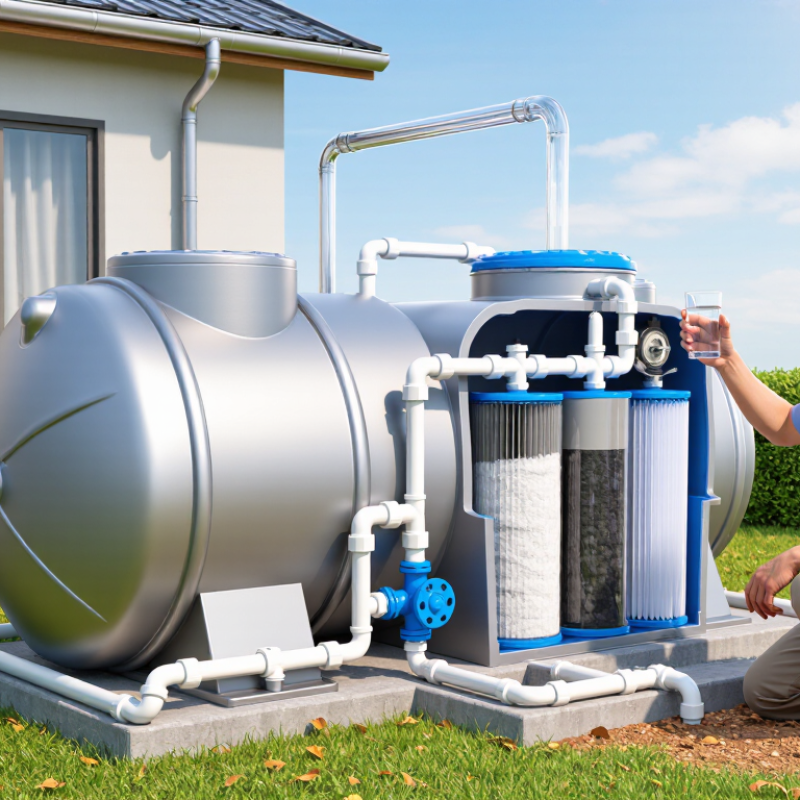
How to Choose the Best Water Tank Filter?

Assess Source Water: EPA Turbidity Benchmarks of 0.3 and 1 NTU

How to Choose the Best Water Tank Filter?

Assess source water before choosing a tank filter. Turbidity measures suspended particles, not every contaminant. EPA’s Surface Water Treatment Rules use 0.3 NTU as a strict performance benchmark. Conventional or direct filtration systems should meet it in at least 95% of measurements. Turbidity should never exceed 1 NTU. These figures describe treated public water systems, not a guaranteed household tank standard. Still, they provide a practical reference.

A tank receiving roof runoff may collect dust, pollen, insects, and fine sediment. Well water can carry iron particles or disturbed soil. I once treated a clear-looking sample as safe. That was a poor assumption. Clear water can still contain microorganisms or dissolved chemicals. Use a calibrated turbidity meter, and test after heavy rain, tank cleaning, or pipe repairs. The EPA’s Revised Total Coliform Rule also supports routine microbial monitoring, because appearance cannot confirm safety. WHO drinking-water guidance notes that lower turbidity helps disinfectants work more reliably.

Tips: Record several readings, not one. If turbidity approaches 0.3 NTU, consider finer sediment filtration. If it reaches 1 NTU, inspect the tank, inlet screen, and settled sludge before selecting replacement media. A filter rated for particles alone may not address pathogens or dissolved pollutants. That limitation deserves attention. The best choice depends on source testing, flow rate, maintenance habits, and verified treatment claims.

Match Contaminants to NSF/ANSI 42, 53, 55, or 58 Standards

Choosing the best water tank filter starts with identifying the contaminants in your stored water. Do not choose by appearance alone. A clear filter housing may still fail to reduce bacteria, lead, or dissolved salts. Use a laboratory water test, recent inspection results, or local water reports when available. Then match the treatment claim to the correct NSF/ANSI standard.

NSF/ANSI 42 covers aesthetic concerns, such as chlorine, taste, odor, and visible particles. NSF/ANSI 53 addresses specific health-related contaminants, including lead, cysts, and selected chemicals. Check the exact contaminant claim, because certification does not cover every hazard. NSF/ANSI 55 applies to ultraviolet systems that reduce microorganisms, but UV needs clear water and reliable power. NSF/ANSI 58 covers reverse osmosis systems, which can reduce many dissolved solids, including certain metals and salts. However, RO systems usually create wastewater and need pressure control.

Tips: Keep the test report beside the product specification sheet. Confirm flow rate, tank capacity, replacement intervals, and certification scope. A filter rated for 1,000 liters may perform poorly in a dusty tank with irregular maintenance. That detail is easy to miss. Inspect sediment buildup, leaks, and UV lamp status on schedule. I have seen users replace cartridges late because the water still looked clean. That approach is unreliable. Certification supports a claim, but installation and maintenance still decide daily performance.

How to Choose the Best Water Tank Filter?

Match Common Contaminants to NSF/ANSI 42, 53, 55, or 58 Standards

This chart shows representative contaminant categories commonly associated with each standard: NSF/ANSI 42 focuses on aesthetic effects, NSF/ANSI 53 on health-related contaminant reduction, NSF/ANSI 55 on ultraviolet microbiological treatment, and NSF/ANSI 58 on reverse osmosis.

A value of 1 indicates a primary representative application, while 0 indicates that the category is not the standard’s primary focus. Actual performance depends on the specific certified filter model and its individual reduction claims. NSF/ANSI 55 applies to UV systems and does not address dissolved chemicals.

Choose Micron Ratings: 1 μm for Cysts and 0.2 μm for Bacteria

Choosing a water tank filter starts with the contaminant, not the price. The WHO/UNICEF Joint Monitoring Programme reported that 2.2 billion people lacked safely managed drinking water in 2022. That figure makes filtration decisions more than a maintenance detail.

For protozoan cysts, a 1 μm absolute-rated filter is a practical starting point. It can help reduce larger organisms, including Giardia and Cryptosporidium cysts. Do not confuse absolute and nominal ratings. A nominal 1 μm filter may allow smaller particles through. The CDC recommends checking certified cyst-reduction claims under relevant NSF/ANSI standards. Certification matters more than a bold number on a package.

Bacteria require tighter control. A 0.2 μm filter can reduce many bacterial cells when its rating is absolute and the housing remains properly sealed. It will not reliably remove viruses, dissolved chemicals, or every microorganism. The WHO Household Water Treatment Evaluation Scheme emphasizes measured log-reduction performance, rather than pore size alone. In a real tank, stagnant water, cracked seals, and biofilm can defeat an excellent cartridge. I have seen clean-looking filters perform poorly after delayed replacement. That was a useful warning. Measure flow, inspect sediment, and follow the manufacturer’s validated service interval. Also test the treated water, especially after long storage or tank cleaning.

Calculate Flow Capacity and Add a 20–30% Performance Safety Margin

When choosing the best water tank filter, start with flow capacity, not tank size. A large tank does not guarantee strong water delivery. Estimate the highest simultaneous demand, such as a shower, toilet, and garden tap running together. Use the filter’s rated flow under realistic pressure, not its maximum laboratory figure.

For example, if your home requires 18 liters per minute during peak use, select a filter rated for at least 21.6 to 23.4 liters per minute. This adds the recommended 20–30% performance safety margin. The extra capacity helps compensate for pressure loss, sediment buildup, colder water, and gradual cartridge loading. Keep it practical. An oversized filter may increase purchase and maintenance costs without improving household performance.

Check pressure before installation. Measure flow at the tank outlet and at the farthest tap, because long pipes and narrow fittings can reduce delivery. Review independent test data, replacement intervals, and cleaning requirements. In real maintenance work, filters often perform below their printed rating after several weeks of use. That detail is easy to miss. A calculation may look exact, yet household demand changes daily. Leave room for those changes, and inspect the pressure gauge regularly. A lower reading can reveal clogging before the shower becomes noticeably weak.

Verify Tank Compatibility Under NSF/ANSI/CAN 61 Material Standards

Choosing the best water tank filter starts with the tank, not the cartridge. NSF/ANSI/CAN 61 evaluates materials and components that contact drinking water. It addresses possible chemical leaching under defined test conditions. The tank body, internal coating, seals, fittings, and filter housing should match the certificate’s stated scope. A certificate for one gasket does not cover the complete assembly.

Check the operating limits carefully. Confirm water temperature, pressure, pH range, disinfectant exposure, and contact time. A tank used for chlorinated water may need different materials than one used for private well water. Also verify flow direction and media retention. A small mismatch can release carbon fines or shorten filter life. I have learned that a polished tank can still be unsuitable.

The U.S. Environmental Protection Agency’s 2023 Drinking Water Needs Survey estimated $625 billion in drinking-water infrastructure needs over 20 years. That figure shows why material durability deserves attention, even in smaller systems. The WHO and UNICEF Joint Monitoring Programme reported that 2.2 billion people lacked safely managed drinking water in 2022. Certification cannot solve every water-quality problem. It also does not prove contaminant-removal performance. Request current documentation, installation limits, and test details from the supplier. Then compare them with your actual water report. Guessing here is tempting, but it is not a reliable method.

How to Choose the Best Water Tank Filter? - Verify Tank Compatibility Under NSF/ANSI/CAN 61 Material Standards

Filter or Component Type Main Function Typical Particle or Contaminant Target Tank Compatibility Checks NSF/ANSI/CAN 61 Material Verification Important Selection Note
Screen or Sediment Filter Removes larger suspended solids before water enters or leaves the tank. Sand, rust flakes, silt, and other visible particles. Confirm connection size, flow direction, pressure rating, cleaning access, and available installation space. Verify that wetted plastic, elastomers, adhesives, coatings, and metal parts are covered by the supplier’s applicable certification or compliance documentation. Choose a mesh or micron rating suitable for the expected solids load without creating excessive pressure loss.
Depth Sediment Cartridge Captures particles throughout the depth of a fibrous or porous filter medium. Fine sediment, turbidity-causing particles, and particulate debris. Check cartridge dimensions, housing compatibility, replacement availability, maximum flow, and differential-pressure limits. Confirm that the cartridge media, core, end caps, sealants, and housing materials intended for drinking-water contact are evaluated under the standard where required. A smaller micron rating may improve particle removal but can clog faster and reduce flow.
Granular Activated Carbon Filter Adsorbs certain taste-, odor-, and organic-compound-causing substances. Chlorine and some organic compounds, depending on carbon type, contact time, and water chemistry. Verify bed volume, empty-bed contact time, backwashing or flushing needs, flow rate, and protection from channeling. Check documentation for the carbon, binder, vessel lining, gasket, and other wetted materials; material compliance does not by itself prove contaminant-removal performance. Replace or regenerate the media according to measured performance and the supplier’s service instructions.
Carbon Block Filter Provides adsorption with a fixed carbon structure that may also reduce particulate matter. Taste and odor compounds, chlorine, and selected contaminants identified by the product performance claim. Confirm operating pressure, flow rate, cartridge fit, prefiltration requirements, and the manufacturer’s replacement interval. Review the exact model’s material certification scope; a certified housing does not automatically certify a replacement cartridge or its internal media. Use an independently verified performance claim for any specific contaminant rather than relying only on the word “carbon.”
Ultrafiltration Membrane Uses a fine membrane barrier to reduce suspended solids and some microorganisms, subject to the tested claim. Particles, colloids, and selected bacteria or cysts when specifically tested and rated. Check feed-water quality, pressure range, flushing method, flow demand, membrane integrity, and cleaning requirements. Verify drinking-water-contact materials for the membrane, potting compound, housing, seals, and tubing; confirm that the certification applies to the complete assembly or relevant components. Do not assume removal of viruses, dissolved chemicals, or all microorganisms unless the specific product has a validated claim.
Reverse Osmosis Membrane Reduces many dissolved salts and selected contaminants by using pressure-driven membrane separation. Dissolved solids and selected ions or chemicals, depending on feed water and verified performance. Confirm pressure, pretreatment, drain or reject-water routing, permeate flow, storage capacity, and compatibility with the tank material. Review material compliance for the membrane module and all wetted components; NSF/ANSI/CAN 61 material evaluation is separate from reduction-performance testing. Pretreatment is often necessary to control chlorine damage, scaling, fouling, or premature membrane failure.
UV Disinfection Chamber Uses ultraviolet light to inactivate microorganisms when the required dose is delivered. Selected bacteria, viruses, and protozoa, depending on dose, transmittance, and validated system performance. Confirm flow rate, UV transmittance, lamp replacement access, electrical protection, chamber pressure rating, and installation orientation. Check the chamber, quartz sleeve, seals, fittings, and other water-contact materials for applicable drinking-water-contact documentation. UV does not remove sediment, dissolved chemicals, or dead microorganisms; prefiltration is commonly needed for effective light transmission.
Tank Outlet or Point-of-Use Filter Provides final treatment immediately before water reaches the point of use. Depends on the installed media, membrane, or treatment technology. Check outlet thread, tubing size, pressure loss, flow demand, hygiene protection, and whether the tank outlet can support the assembly. Verify every component in contact with treated water, including connectors, tubing, seals, and fittings, rather than checking only the outer housing. A final filter cannot correct unsafe tank construction, poor sanitation, or contamination introduced upstream.
Verification Checklist: NSF/ANSI/CAN 61 evaluates the health effects of materials, components, and systems that contact drinking water. It does not, by itself, certify a filter’s contaminant-removal efficiency. Before purchase, verify the exact model, intended water temperature, pressure and flow limits, wetted-material coverage, installation instructions, replacement schedule, and an up-to-date certification record from an accredited conformity-assessment organization.
Shopping Basket