7 Tips for Choosing Alkali Resistant Fiberglass Mesh
Wall cracks rarely begin with one dramatic failure. More often, a weak joint, poor installation, or unsuitable reinforcement creates trouble over time. Alkali Resistant Fiberglass Mesh is commonly used to reinforce plaster, stucco, and exterior insulation systems, where it must withstand alkaline materials and help distribute stress. But products that look alike on a shop shelf may differ in mesh size, fabric weight, coating, and documented performance.
A useful choice starts with the application, not just the price. Check whether the mesh is intended for your system, and review its technical data for alkali resistance, tensile strength, and mesh dimensions. Ask for clear product documentation rather than relying on a broad label. Small details matter. A mesh that is too light or poorly suited to the base coat may be difficult to install well, even when its description sounds convincing. Installation also counts: correct overlaps, full embedment, and careful handling can affect the finished reinforcement. There is no single specification that fits every wall or project. The right selection depends on the substrate, exposure, finish, and manufacturer’s instructions. Some product claims can be hard to compare, so pause when key details are missing. These seven tips will help you assess Alkali Resistant Fiberglass Mesh with practical questions, not guesswork, and make a more informed choice for your project.
Define the Exposure Conditions and Reinforcement Role Before Selecting Mesh
7 Tips for Choosing Alkali Resistant Fiberglass Mesh
Define the exposure before comparing mesh specifications.
Will the mesh sit in cement render, a wet exterior wall, or a sheltered interior finish? ACI guidance reports concrete pore-solution pH commonly around 12.5–13.5, a strongly alkaline environment. Repeated wetting and drying can add another stress. I still see exposure descriptions reduced to “outdoor,” which is not specific enough.
Tip: Check moisture. Note temperature swings. Identify the cement layer. Confirm whether freeze-thaw applies. Specify the mesh location. Ask for alkali-resistance test data. Keep the product documentation. Small details matter.
Then define the reinforcement role. Mesh used to distribute shrinkage cracks in a thin render does not automatically replace structural reinforcement. Record the substrate, layer thickness, overlap, and expected crack pattern before selecting mesh weight and opening size. ASTM C1666/C1666M sets a minimum of 16% zirconia for alkali-resistant glass fiber; ask suppliers for test reports and confirm they cover the mesh, not only the raw fiber. A certificate helps, but installation details can still undermine performance. That part is easy to overlook.
Verify AR Glass Chemistry Against ASTM C1666/C1666M’s 16% ZrO₂ Minimum
When choosing alkali resistant fiberglass mesh, check the glass chemistry, not just the product label. ASTM C1666/C1666M specifies a minimum zirconium dioxide (ZrO₂) content of 16% for AR glass fiber. Ask for a test certificate tied to the mesh’s production lot, and confirm the reported value meets that threshold. A general statement such as “alkali resistant” does not show the actual composition. Small detail, but important.
Review the test method, sample identification, and document date. If the mesh has a coating, remember that coating performance does not prove the glass meets the ZrO₂ requirement. Request supporting laboratory data, such as X-ray fluorescence results, when the certificate lacks detail. Check that the data applies to the fiber used in the mesh, not another product from the same supplier. Paperwork can lag production, so verify that the lot numbers match. Even good documentation has limits; it cannot replace checking the mesh’s condition and suitability for your intended cement-based application.
Match Mesh Weight and Aperture to the Render or Insulation System
Match the mesh to the full render or insulation system, not just the wall surface. Mesh weight, usually listed in grams per square metre, affects handling and reinforcement, but heavier is not automatically better. A thick mesh may be difficult to bed flat in a thin base coat. Check the system specification for the approved weight and confirm the mesh is designed to resist the alkaline environment of cement-based materials.
Aperture size matters too. The openings must let fresh mortar pass through and grip the fibres, while still providing enough reinforcement across the coat. If the mesh is too open, it may not distribute stress as intended; if it is too tight, bedding it evenly can take extra care. Small details matter. Follow the specified overlap, and make sure the mesh sits within the reinforced layer rather than directly against the insulation.
For example, a render system on mineral wool may call for a different mesh weight or opening than a thinner system on rigid insulation. Use the stated system requirements rather than guessing from appearance. I would not assume a mesh that worked on one wall will suit another; substrate movement, coat thickness, and exposure can change the choice. It is easy to overlook the corners, where neatly embedded mesh and consistent coverage are especially important.
Check Aged Tensile Strength Against ETAG 004’s 20 N/mm ETICS Benchmark
When choosing alkali resistant fiberglass mesh, check its tensile strength after aging—not just the new roll’s figures. Cement-based render is alkaline, and exposure can weaken glass fibers over time. ETAG 004 uses 20 N/mm as a benchmark for aged tensile strength in ETICS mesh assessments. Confirm the test direction and method, since warp and weft results may differ. Ask for a test report that identifies the mesh and states the measured value after aging. A vague “high strength” claim tells you little.
Look at strength retention too. A mesh may meet 20 N/mm yet lose a large share of its original strength, so compare aged and initial results where available. Check that the report reflects alkaline conditioning, not only a dry tensile test.
Then inspect the weave: consistent openings and firm coating help the mesh sit evenly in fresh base coat. Small details matter. On a sample, look for loose strands or coating that flakes when bent. They are warning signs, though not proof of failure.
One imperfect point: lab results cannot fully predict workmanship, storage, or exposure on your wall. Use the benchmark as a screening tool, and verify that the mesh is intended for the specific ETICS system and installation conditions.
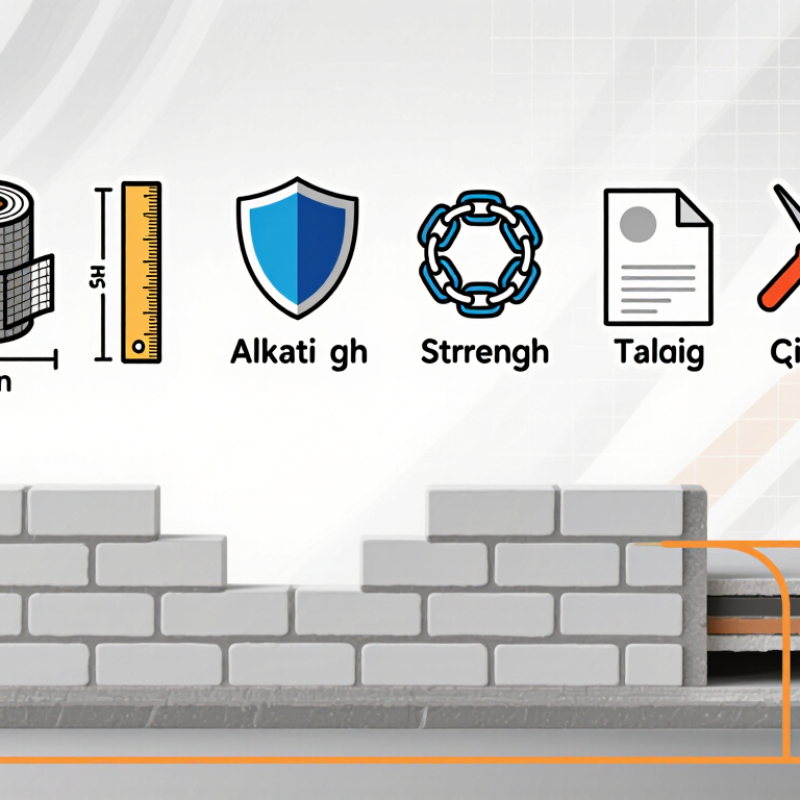
Confirm Coating, Roll Dimensions, and Test Certificates Meet Project Specifications
Choosing alkali-resistant fiberglass mesh starts with the coating, not just the stated weight. Ask whether the coating is suitable for the project’s mortar or render system. Confirm the specified alkali-resistance test method and acceptance values. A mesh can look sound on the roll yet perform poorly after exposure. Appearance is not proof.
Check roll width and length against the drawings and installation plan. A narrow roll may create extra joints around openings, while an oversized roll can be awkward on scaffolding. Verify the usable dimensions, not only the label. Measure a sample roll if quantities are tight. Small discrepancies can slow a crew down.
Request test certificates that identify the mesh type, coating, test method, results, and production batch. Compare those details with the project specification before ordering. Generic certificates are less useful when they cannot be linked to the delivered material. Keep the documents with delivery records, and inspect labels when rolls arrive. I have seen buyers focus heavily on strength figures and overlook batch traceability. That is an easy gap to miss. If a certificate or dimension is unclear, ask for written confirmation before installation.
7 Tips for Choosing Alkali Resistant Fiberglass Mesh
Confirm coating, roll dimensions, and test certificates meet project specifications.
Illustrative sample review: bars show the share of requested documentation available for each check. These example scores are not product ratings or universal requirements; confirm acceptance limits and required evidence in the project specification.