
• Home
  • About
    • jute Bag

      Eco-Chic and Durable – Perfect for Sustainable Living.

      Cashew Nut Bag

      Sustainable jute bag for lasting cashew nut freshness

      Cocoa Bag

      Eco-friendly jute bag for rich cocoa flavor preservation

      Coffee Bag

      Elegant, durable jute bag to keep coffee beans fresh and eco-friendly

      Hazel Nut Bag

      Eco-conscious jute bag for hazelnut freshness and quality

      Shea Nut Bag

      Durable jute bag for fresh, organic shea nuts

      Tote Bag

      Stylish, eco-friendly jute tote for daily essentials

      Wheat Bag

      Sustainable jute bag for optimal wheat freshness

    • Jute Yarn

      Eco-Chic and Durable – Perfect for Sustainable Living.

      Jute Rope

      Sustainable jute bag for lasting cashew nut freshness

      Jute Fabrics

      Eco-friendly jute bag for rich cocoa flavor preservation

      Hessian cloth

      Sustainable Hessian cloth suppliers

  • Products
  • Export Country
  • Blog

Top 10 Luggage Replacement Wheels for Suitcases

A suitcase often fails at the wheel before the fabric, handle, or frame gives way. That small defect can turn a smooth airport transfer into a rough, noisy struggle. This guide reviews the top 10 luggage replacement wheels for suitcases, focusing on fit, load capacity, rolling comfort, tread design, bearings, axle size, and installation effort.

The market deserves careful reading. Grand View Research valued the global luggage market at approximately USD 22.37 billion in 2023 and projected continued growth through 2030. Its analysis also reflects rising demand for durable, repairable travel products. However, market reports measure luggage sales, not replacement-wheel purchases. That distinction matters. A large luggage market does not automatically prove strong wheel demand.

Travel journalist and consumer advocate Rick Steves has often promoted a simple principle: “The less you carry, the more you enjoy travel.” The idea applies here. A lighter suitcase places less pressure on wheel housings, bearings, and axles. Still, weight is only one part of the decision.

This comparison examines real-world details, including cracked wheel forks, loose screws, uneven sidewalks, and crowded terminal floors. Some models look sturdy but roll poorly under load. Others install easily yet produce excessive vibration. No ranking is perfect. Suitcase brands use different mounting systems, and compatibility can be frustrating. Measure twice.

The strongest luggage replacement wheels should restore movement, reduce noise, and survive repeated travel. They should not merely look impressive in product photographs.
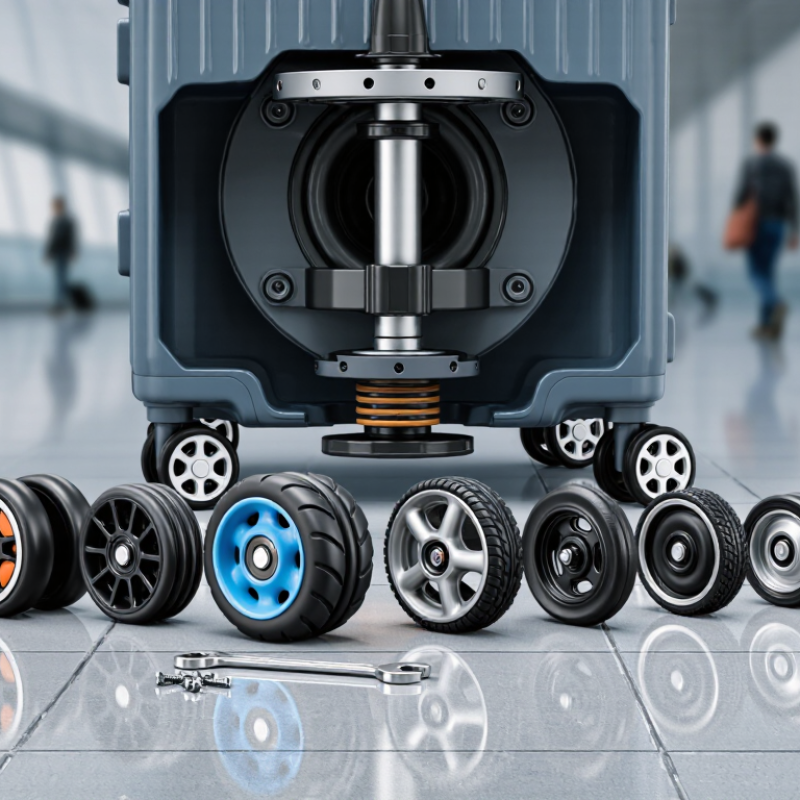
Top 10 Luggage Replacement Wheels for Suitcases

Understanding Suitcase Wheel Types and Replacement Requirements

Top 10 Luggage Replacement Wheels for Suitcases

Understanding suitcase wheel types prevents costly fitting mistakes. Suitcases commonly use spinner, inline, single, and double-wheel designs. Spinner wheels rotate 360 degrees and usually sit in corner housings. Inline wheels run in one direction and often handle uneven pavement better. Some models use recessed wheels, which protect the housing but reduce internal packing space.

Replacement requirements begin with accurate measurements. Record wheel diameter, width, axle diameter, and axle length. Measure the mounting plate, screw spacing, and available clearance. Even a two-millimeter difference can cause rubbing. Check whether the wheel uses screws, rivets, or a sealed axle. Matching the attachment method matters as much as matching the wheel shape. Rubber wheels often feel quieter, while harder materials may roll efficiently on smooth floors.

Inspect the frame before ordering. Cracks, bent brackets, and loose plates can make a new wheel unsafe. Choose a replacement rated for the suitcase’s typical load, not only its empty weight. I once measured the wheel correctly but ignored the axle head, so the replacement sat unevenly. That mistake was avoidable. After installation, test every direction on a clean floor. Listen for clicking, then check the screws again after a short trip. A little looseness can become a serious wobble.

How to Identify the Right Replacement Wheels for Your Luggage

How to Identify the Right Replacement Wheels for Your Luggage

Choosing replacement wheels starts with measurement, not appearance. A wheel that looks compatible may have a different axle diameter, bracket width, or mounting-hole pattern. Measure the wheel diameter, tread width, axle length, and space between mounting points. Record everything in millimeters. A small mismatch can cause wobbling.

I once selected wheels by matching only the visible shape. They fitted the suitcase but scraped the shell during turns. That mistake changed my checking routine. I now photograph the original assembly before removal and compare its orientation carefully. Check whether your case uses single, double, spinner, or inline wheels. Also inspect the wheel housing for cracks. New wheels cannot fix damaged mounting points.

SITA’s 2024 Baggage IT Insights report recorded 36.1 million mishandled bags in 2023, equal to 6.9 bags per 1,000 passengers. Rough handling makes stronger wheel construction important.

Look for reinforced hubs, sealed bearings, and abrasion-resistant polyurethane or rubber treads. Ask for a stated load rating, if available. Hard plastic may roll efficiently on smooth floors but feels harsh on pavement. Soft rubber absorbs vibration better, though it may wear faster. Compatibility matters more than advertising claims. Keep the old axle until the replacement rolls freely, clears the case, and stays aligned under a loaded-bag test.

Top 10 Luggage Replacement Wheels for Suitcases

Top 10 Luggage Replacement Wheels for Suitcases

Choosing among the top 10 luggage replacement wheels for suitcases starts with wheel design, not appearance. Single spinner wheels suit compact cases and narrow aisles. Dual spinner wheels offer better balance on smooth floors. Recessed wheels protect the frame but reduce packing space. Inline skate wheels roll well over sidewalks, while rubber-coated wheels reduce vibration. Polyurethane wheels usually resist wear better than basic plastic. Ball-bearing wheels can feel smoother under heavier loads. Silent wheels help in hotels and offices. Heavy-duty wheels suit frequent travelers. Universal-fit wheels simplify repairs. Measure carefully.

SITA’s Baggage IT Insights 2024 reported 6.9 mishandled bags per 1,000 passengers in 2023. That figure shows how much luggage moves through rough handling systems. A stronger replacement wheel cannot prevent every impact, but it can improve control. Check axle width, wheel diameter, housing clearance, and screw spacing before ordering. A wheel that spins freely in your hand may rub against the suitcase shell after installation.

I learned this the hard way. My first replacement looked compatible, yet the axle was too short. The wheel wobbled after one trip. For practical testing, roll the suitcase over tile, carpet, and a broken pavement edge. Listen for clicking. Check side-to-side movement. The best choice is not always the largest wheel. It is the wheel that matches the case, load, and route. According to the International Air Transport Association, baggage handling continues to depend on fast, repeated transfers, so secure installation matters more than glossy packaging.

Top 10 Luggage Replacement Wheels for Suitcases

Comparison of common replacement-wheel configurations by wheel diameter and width.

Larger wheels generally roll more smoothly over uneven surfaces, while wider wheels can provide improved stability. These ten configurations use common replacement-wheel dimensions for carry-on and checked luggage.

Comparing Wheel Materials, Designs, Durability, and Compatibility

Top 10 Luggage Replacement Wheels for Suitcases

Choosing replacement wheels requires more than matching a suitcase’s appearance. In repair work, I compare material, wheel shape, bearings, and mounting dimensions. Polyurethane wheels usually roll quietly on airport floors and resist abrasion. Rubber offers stronger grip but may wear faster on rough pavement. Nylon handles impacts well, although it can sound harsh on tile. Noise matters.

Wheel design changes handling. Spinner wheels rotate freely in every direction, making crowded terminals easier to navigate. Inline wheels track steadily and often survive heavier pulling forces. Recessed wheels receive better protection inside the case shell. However, their smaller diameter may struggle over carpet or broken sidewalks. A larger wheel usually clears obstacles better, but it needs enough housing space.

Compatibility is where many replacements fail. Measure the wheel diameter, width, axle diameter, and mounting-hole spacing. Check the available clearance around the wheel housing. Some models use single wheels, while others require paired assemblies. Sealed bearings can reduce grit-related friction, but they do not fix a bent bracket. I have seen durable wheels fail because an old axle was reused. That mistake is easy to miss.

Load ratings help, but they are not universal. Test the wheel with a packed suitcase before traveling. Push it across tile, carpet, and a curb edge. A perfect wheel does not exist. Comfort, strength, noise, and fit always involve compromise.

Top 10 Luggage Replacement Wheels for Suitcases - Comparing Wheel Materials, Designs, Durability, and Compatibility
Rank Replacement Wheel Type Wheel Material Design Typical Wheel Diameter Typical Wheel Width Approx. Load Capacity Durability Characteristics Noise and Ride Quality Common Compatibility Installation Requirement Best Use
1 Twin Spinner Wheel Set Polyurethane tread with nylon core Four-wheel, 360-degree twin-spinner design 50–60 mm 18–22 mm per wheel 20–25 kg per pair Good resistance to abrasion, cracking, and moderate impact Low noise; smooth on tile and polished floors Suitcases using twin-wheel spinner housings with matching screw or rivet spacing Usually requires housing removal; axle or fastener measurement is essential Frequent travelers who want balanced maneuverability and stability
2 Single Spinner Wheel Set Thermoplastic polyurethane with polypropylene hub Single-wheel 360-degree spinner design 55–65 mm 20–25 mm 18–22 kg per pair Flexible tread helps absorb small surface irregularities Low to moderate noise; easy directional changes Cases with removable single-spinner wheel modules and compatible axle length May be screw-mounted or riveted; bracket dimensions must match General airport, hotel, and urban travel
3 Inline Skate-Style Wheel Polyurethane outer layer with aluminum or nylon bearing core Two-wheel, one-direction rolling design 70–80 mm 20–24 mm 25–30 kg per pair Large diameter reduces rolling resistance and handles uneven pavement better Low noise when fitted with sealed bearings Two-wheel luggage with open wheel forks and a compatible axle diameter Requires axle, spacer, and wheel-width measurements Heavy luggage and outdoor sidewalks
4 Heavy-Duty Twin Wheel High-density polyurethane with reinforced nylon hub Wide twin-wheel design with reinforced sidewalls 60–70 mm 24–30 mm per wheel 28–35 kg per pair High load tolerance and improved resistance to deformation Moderate noise; stable on rougher surfaces Large suitcases with a reinforced external wheel bracket Bracket width, axle diameter, and screw-hole spacing must be checked Checked luggage and extended trips
5 Quiet Soft-Tread Spinner Wheel Soft thermoplastic rubber with steel or nylon bearing support Single-wheel spinner with resilient soft tread 50–60 mm 18–22 mm 15–20 kg per pair Excellent vibration absorption; softer tread may wear faster on rough concrete Very low noise on indoor flooring Compact carry-on cases with compatible spinner sockets Often requires a matching axle pin or replacement mounting bracket Office buildings, hotels, and quiet indoor environments
6 Universal Screw-Mount Wheel Polyurethane tread with molded ABS or nylon body Modular wheel with adjustable screw-mounted bracket 55–65 mm 20–26 mm 18–25 kg per pair Practical replacement option; durability depends heavily on bracket alignment Moderate noise; smooth on hard floors Cases with accessible screw holes and sufficient mounting clearance Requires accurate hole-spacing, screw-length, and bracket-height measurements DIY repairs where the original housing is damaged
7 Rivet-Mount Replacement Wheel Nylon or polypropylene wheel with rubberized tread Fixed wheel module designed for permanent mounting 45–60 mm 18–24 mm 15–22 kg per pair Secure after installation, but removal and fitting are more labor-intensive Moderate noise; dependable on smooth surfaces Suitcases originally fitted with riveted wheel assemblies Requires drilling out old rivets and installing new rivets or bolts Older luggage with non-removable wheel housings
8 Bearing-Enhanced Spinner Wheel Polyurethane tread with sealed stainless-steel bearings Single or twin spinner configuration with precision bearings 50–65 mm 18–25 mm 20–28 kg per pair Reduced friction and better resistance to wheel wobble when correctly installed Low noise; smooth rolling with minimal drag Wheel housings designed for standard bearing-supported axles Axle diameter, bearing width, and internal spacer length must match Travelers prioritizing smooth movement and long-term rolling performance
9 Compact Carry-On Wheel Thermoplastic rubber with lightweight polypropylene core Small single-wheel or twin-wheel design 40–50 mm 16–20 mm 12–18 kg per pair Lightweight construction reduces case weight but offers less impact tolerance Low noise on smooth indoor floors Small carry-on cases with compact wheel cavities Requires cavity depth, axle length, and side-clearance verification Light packing and short business trips
10 Rugged Outdoor Wheel Hard polyurethane tread with reinforced nylon or metal hub Large fixed wheel with deep sidewall and high ground clearance 65–75 mm 24–30 mm 25–32 kg per pair Strong impact resistance and better performance on pavement, ramps, and uneven paths Moderate noise; firm ride on indoor floors Two-wheel luggage with adequate fork clearance and a matching axle system May require new spacers, washers, or a longer axle Outdoor travel, cobblestones, and heavily loaded luggage

Compatibility depends on the original wheel diameter, wheel width, axle diameter, axle length, bearing size, bracket height, screw-hole spacing, and available clearance. Measure the original assembly before purchasing; load capacities are typical pair ratings for properly installed wheels and should not be treated as a suitcase manufacturer’s certified limit.

Step-by-Step Guide to Installing and Maintaining Replacement Wheels

Replacing suitcase wheels is easier when you treat the job like a small mechanical repair. Measure the wheel diameter, width, axle length, and mounting space before ordering. Matching only the wheel’s appearance can create wobbling or poor clearance. A ruler and caliper provide more reliable measurements than guessing.

Place the suitcase on a clean table. Open the lining if the wheel housing is hidden. Remove the axle with the correct screwdriver or wrench, then keep every washer nearby. Install the new wheel in the same direction as the original. Tighten the axle until the wheel feels secure, but still spins freely. Do not force a stripped screw.

Test it carefully. Roll the case across tile, carpet, and a doorway edge. Listen for clicking, rubbing, or uneven movement. I once tightened a wheel too much, and it stopped turning after a few minutes. That mistake reminded me to check rotation before packing. Small gaps can collect thread and dust, so inspect them after each trip.

For maintenance, wipe the wheels with a dry cloth and remove hair from the axle area. Use a small amount of suitable lubricant only when the wheel joint allows it. Excess oil attracts grit. Check loose fasteners every few months, especially after rough travel. Replacement wheels can last well, but overloaded cases still shorten their service life.

Article Source:

Shopping Basket