Top 10 Unflavored Gelatin Wholesale Suppliers for Buyers
Unflavored Gelatin Wholesale buying can look simple: compare prices, check the bag weight, and request a sample. In practice, the details matter. A food manufacturer may need a consistent bloom strength, clear color, neutral odor, and dependable performance from one shipment to the next. A small change can affect a set dessert, a gummy’s bite, or the clarity of a prepared product. Buyers should also confirm grade, origin, packaging, storage guidance, lead time, and available quality documents before placing a bulk order.
Hydrocolloid scientist Dr. Glyn O. Phillips is a useful reference point for understanding gelatin’s functional role. I can’t verify a verbatim quotation from him about wholesale sourcing, so this guide uses an editorial buying principle instead: “A low price matters only when the material performs consistently.” That distinction is easy to overlook. A sample may look fine on a bright counter, yet tell little about repeat orders or transport conditions. Ask suppliers how they maintain lot consistency, and compare answers alongside specifications—not instead of them.
This Top 10 guide is designed to help buyers assess suppliers with practical questions in mind. Look for transparent product information, responsive technical support, realistic minimum order quantities, and clear sample procedures. Check whether claims are documented, not merely promised. Some suppliers may suit large production runs; others may offer more flexibility to smaller buyers. No list can replace your own testing. Still, a careful shortlist can save time, reduce avoidable surprises, and make the next sourcing conversation more precise.
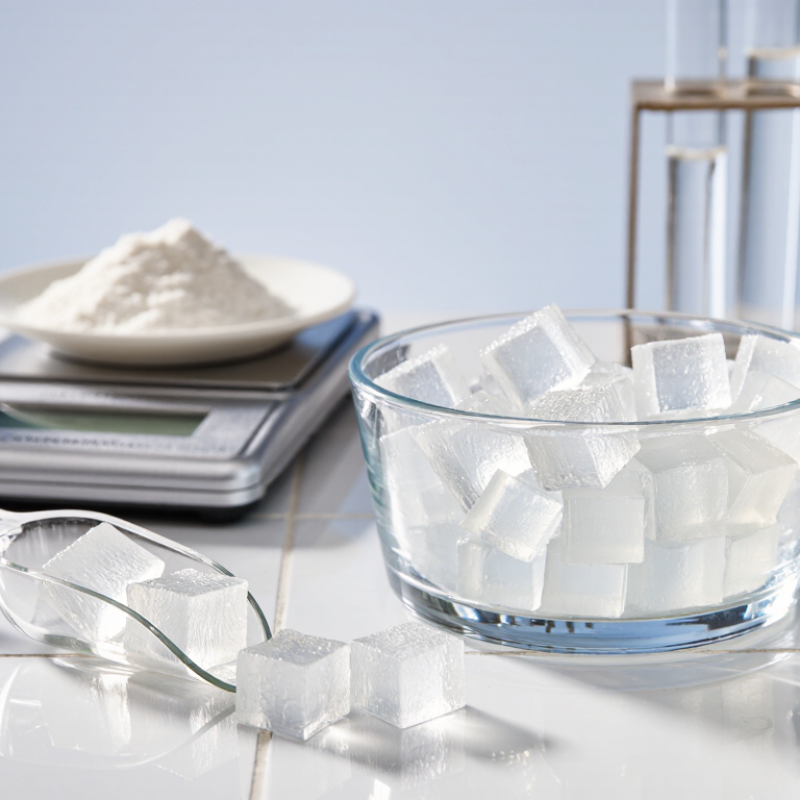
How Unflavored Gelatin Is Defined: E441, Sources, and Food-Grade Uses
Unflavored gelatin is a purified protein made by partially breaking down collagen. Commercial sources commonly include cattle and pig hides or bones, as well as fish skin and scales. In the European Union, gelatin used as a food additive is identified as E441. That code identifies the additive; it does not tell buyers which animal source was used. Ask for source declarations, food-grade specifications, and a lot-specific certificate of analysis. Small details matter.
The Gelatin Manufacturers of Europe’s industry overview estimates global gelatin production at about 450,000 metric tonnes annually. This is an industry estimate, not a measure of available food-grade supply, and sourcing can vary by region. In foods, gelatin helps set gummies and desserts, stabilizes some dairy products, and clarifies certain beverages. Its familiar springy texture comes from a gel that softens when warmed. A useful check.
EFSA’s 2017 re-evaluation found no safety concern at the reported uses and use levels, and did not establish a numerical acceptable daily intake. Buyers still need to verify specifications and intended-use suitability for each purchase. “Unflavored” describes taste, not source or performance. And one point is easy to miss: bloom strength, particle size, and source can change how a batch behaves in a kettle. Supplier documents help, but a small production trial is still sensible.
Buyer Specifications: GMIA’s 50–300 Bloom Strength Range and Quality Tests
For buyers comparing unflavored gelatin wholesale suppliers, Bloom strength is a practical starting point. GMIA’s commonly referenced 50–300 Bloom range covers products with different gelling strengths. A higher number generally indicates a firmer gel, but it does not guarantee better performance in every recipe. Ask suppliers to state the Bloom value, test method, and lot number on the specification sheet or certificate of analysis. Small differences matter.
Check more than Bloom. Request results for moisture, ash, pH, viscosity, color, odor, and microbiological quality. Confirm particle size and dissolution behavior if the gelatin must blend into a specific process. Compare samples under your own conditions: weigh the powder, control water temperature, and record setting time and texture. One detail is easy to miss. A supplier’s sample may not represent the next production lot, so request lot-specific documents and retain a sample for comparison.
Tips: Set an acceptable Bloom range before requesting quotes, rather than choosing by price alone. Keep test conditions consistent, including concentration, temperature, and setting time. If results look unusual, repeat the test and ask the supplier to clarify its method. Specifications are useful, but they are not a substitute for a production trial.
Top 10 Unflavored Gelatin Wholesale Suppliers by Region and Product Range
Top 10 Unflavored Gelatin Wholesale Suppliers for Buyers
Top 10 Unflavored Gelatin Wholesale Suppliers by Region and Product Range
Comparing wholesale suppliers by region helps buyers match product specifications with shipping needs. European and North American catalogs commonly include bovine and porcine gelatin in powder, granule, and sheet forms. Asian suppliers may offer fish gelatin alongside animal-derived options. Availability varies, so check each supplier’s current catalog. Grand View Research’s 2024 gelatin market report estimated the global market at USD 3.2 billion in 2023, with projected growth of 6.6% annually from 2024 to 2030. That growth points to broadening demand, but it does not guarantee uniform supply.
Product range matters as much as location. Ask for bloom strength, mesh size, moisture limits, origin documentation, and lot-specific certificates of analysis. A sample should dissolve cleanly and set consistently in your actual recipe. Small details count. A regional map can mislead: nearby suppliers may still rely on distant processing or variable raw-material sources.
Tips: Compare quotes on equivalent grades and packaging weights. Confirm minimum orders, lead times, and storage conditions in writing. Record sample results before placing a bulk order. One limitation remains: published market figures describe the wider gelatin category, not unflavored wholesale volumes specifically.
Compare Suppliers on MOQ, Traceability, Certifications, and Lead Times
Compare unflavored gelatin wholesalers using the same request sheet: grade, origin, MOQ, documents, and quoted lead time. Ask whether MOQ applies per order, production run, or packaging format; a low pallet minimum may still hide a large custom-bag commitment. Request a recent lot-specific certificate of analysis, animal-source statement, and traceability example. Check that the lot code links to raw-material records, not merely a warehouse label. Small details count.
Certifications should match your market and product use. Verify the certificate holder, site, scope, and expiry date with the issuing body; a logo alone proves little. For lead times, request both standard and peak-season estimates, plus the date the clock starts. McKinsey’s 2020 supply-chain resilience survey found that 93% of surveyed executives planned to make their supply chains more resilient. That finding supports checking backup capacity, not just the lowest quote. FDA traceability record requirements apply to foods on its Food Traceability List, so confirm scope rather than assuming every gelatin product is covered. Compare actual shipment histories where available. One caveat: supplier estimates can change, and buyers should recheck them before committing.
Verify Samples, Certificates of Analysis, and Batch Consistency Before Ordering
A supplier’s sample is only a starting point. Ask for a sealed sample from the same production grade and compare it with the certificate of analysis (COA) for that lot. Record bloom strength, viscosity, moisture, color, odor, and dissolution behavior using consistent test conditions. The Gelatin Manufacturers Institute of America’s Gelatin Handbook describes bloom strength as a key measure of gel firmness; it is meaningful only when the method and sample preparation are controlled. Small differences in water temperature or soaking time can change results. Numbers can drift.
Check the COA’s test methods, units, issue date, and lot number, then compare results across several recent batches. FAO/WHO JECFA’s gelatin specification sets limits including no more than 18% loss on drying and 2% ash. These are useful reference points, not a substitute for confirming the requirements for your product and market. Ask suppliers for relevant food-safety and quality-system certificates, and verify their scope and validity with the issuing body. A certificate alone does not prove every shipment matches the sample. Keep retained samples, document receiving checks, and investigate unexplained changes in clarity, smell, or setting time. This takes effort, but skipping it can make a low-cost purchase expensive.