
• Home
  • About
    • jute Bag

      Eco-Chic and Durable – Perfect for Sustainable Living.

      Cashew Nut Bag

      Sustainable jute bag for lasting cashew nut freshness

      Cocoa Bag

      Eco-friendly jute bag for rich cocoa flavor preservation

      Coffee Bag

      Elegant, durable jute bag to keep coffee beans fresh and eco-friendly

      Hazel Nut Bag

      Eco-conscious jute bag for hazelnut freshness and quality

      Shea Nut Bag

      Durable jute bag for fresh, organic shea nuts

      Tote Bag

      Stylish, eco-friendly jute tote for daily essentials

      Wheat Bag

      Sustainable jute bag for optimal wheat freshness

    • Jute Yarn

      Eco-Chic and Durable – Perfect for Sustainable Living.

      Jute Rope

      Sustainable jute bag for lasting cashew nut freshness

      Jute Fabrics

      Eco-friendly jute bag for rich cocoa flavor preservation

      Hessian cloth

      Sustainable Hessian cloth suppliers

  • Products
  • Export Country
  • Blog

Top 10 Water Chiller Evaporator Types for Global Buyers

Choosing the right Water Chiller Evaporator is rarely a simple matter of comparing catalogue prices. Global buyers must examine cooling capacity, refrigerant compatibility, water quality, pressure drop, maintenance access, and operating climate. A unit serving a clean data center may perform differently from one cooling process water in a dusty factory.

This guide introduces ten important evaporator types used in modern water chiller systems. They include shell-and-tube, brazed-plate, flooded, direct-expansion, falling-film, plate-and-shell, coaxial, spiral, and other specialized designs. Each option has practical strengths. Each also has limits. A compact brazed-plate exchanger can save space, but poor filtration may create serious blockage risks. A flooded evaporator can deliver strong heat-transfer performance, yet it often demands careful refrigerant management and skilled servicing.

Kim Fausing, President and CEO of Danfoss, has stated, “The greenest energy is the energy you don’t use.” That principle matters here. Evaporator selection affects compressor workload, pump energy, refrigerant charge, cleaning frequency, and long-term reliability. Small design choices can become large operating costs.

No single evaporator wins every project. That assumption fails.

The ranking in this article is therefore practical, not absolute. It considers efficiency, durability, installation conditions, serviceability, and buyer experience across international markets. Some conclusions may require adjustment. Local water chemistry, technical standards, spare-parts access, and installer expertise can change the final decision. Use these ten types as a clear starting point, then verify every choice against actual site data.
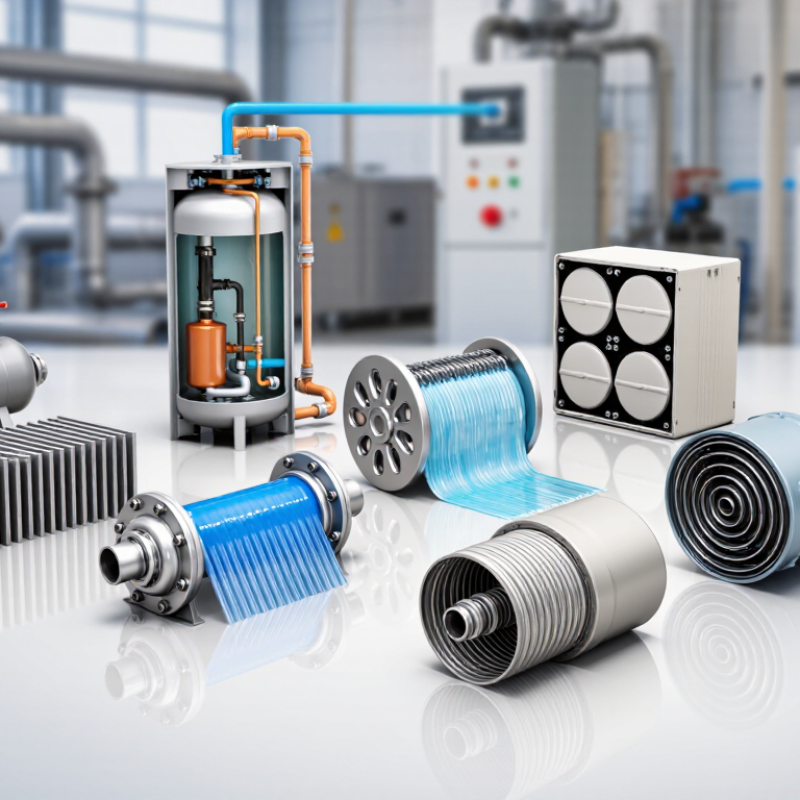
Top 10 Water Chiller Evaporator Types for Global Buyers

Water Chiller Evaporators: Role, Structure, and Operating Principles

Top 10 Water Chiller Evaporator Types for Global Buyers

Water chiller evaporators transfer heat from chilled water into refrigerant. This process lowers water temperature for air-conditioning or industrial cooling. Inside, refrigerant absorbs heat and changes from liquid to vapor. The compressor then receives this low-pressure vapor.

Common designs include shell-and-tube, brazed plate, gasketed plate, flooded, direct-expansion, falling-film, dry-expansion, spiral, microchannel, and spray evaporators. Shell-and-tube units tolerate variable water quality and are easier to inspect. Plate evaporators offer compact dimensions and strong heat transfer. However, narrow channels can block more easily when filtration is weak.

Structure matters. A shell-and-tube model places tubes inside a cylindrical shell, while a plate model uses stacked metal plates and sealed passages. Sensors monitor pressure, inlet temperature, outlet temperature, and refrigerant superheat. In field inspections, poor flow balance often causes uneven cooling. The outlet may look normal while one section remains warm. That detail is easy to miss.

Operating conditions decide suitability. Clean water supports efficient plate designs. Hard water may require accessible tube surfaces and regular descaling. Flooded evaporators can deliver stable heat transfer, but their refrigerant control is more demanding. Direct-expansion units use less refrigerant inventory, yet incorrect superheat settings may damage the compressor. No evaporator is perfect. A careful buyer should compare load, flow rate, fouling risk, maintenance access, and local service skills before choosing one.

Classification of the Top 10 Water Chiller Evaporator Types

Classification of the Top 10 Water Chiller Evaporator Types

Water chiller evaporators are commonly classified by heat-transfer structure and refrigerant flow. The ten practical types include shell-and-tube, brazed plate, gasketed plate, plate-and-shell, coaxial, tube-in-tube, flooded shell-and-tube, dry-expansion shell-and-tube, falling-film, and spray evaporators. Each design handles water flow, refrigerant distribution, and maintenance differently. Shell-and-tube models suit stable industrial loads and tolerate moderate water-side fouling. Brazed plate units are compact, efficient, and useful where floor space is limited. Gasketed plates allow easier cleaning and capacity adjustment, but gasket aging needs attention.

Flooded evaporators keep the refrigerant side highly wetted, supporting strong heat transfer. Dry-expansion designs use controlled refrigerant feeding and usually need less refrigerant charge. Falling-film units can improve efficiency at larger capacities, while spray evaporators distribute refrigerant over internal tubes. Coaxial and tube-in-tube types fit smaller systems, though their passageways may restrict flow. Plate-and-shell units offer a useful compromise between compactness and serviceability. No type is universally best.

Tips: Match the evaporator to entering water temperature, flow rate, pressure drop, and water quality. Check cleaning access before purchase. A narrow passage may perform well on clean water but struggle with suspended solids. In field evaluations, I would also inspect insulation, drainage, sensor placement, and freeze protection. Selection is not always neat. A technically efficient evaporator can become a poor choice when local service skills or replacement parts are limited.

Performance Differences Among the Ten Evaporator Designs

Top 10 Water Chiller Evaporator Types for Global Buyers

Performance Differences Among the Ten Evaporator Designs

Evaporator design strongly affects heat transfer, pressure loss, fouling tolerance, and service access. Bare-tube coils are simple but usually need more surface area. Tube-in-tube and coaxial designs suit smaller systems, although their water paths can restrict flow. Shell-and-tube evaporators offer strong durability and easier mechanical cleaning. Flooded shell-and-tube models typically achieve high heat-transfer efficiency because refrigerant fully wets the tubes. Direct-expansion shell-and-tube units use less refrigerant, but uneven distribution may reduce performance at part load.

Brazed-plate evaporators are compact and often deliver low approach temperatures. However, narrow channels react badly to debris and poor water treatment. Gasketed plate-and-frame designs allow plate replacement, making maintenance more flexible. Falling-film evaporators can reduce refrigerant charge and improve efficiency, but distribution quality is critical. Spray-film designs increase refrigerant contact with tubes, yet nozzle blockage remains a practical concern. Spiral evaporators resist some fouling and provide a small footprint, though inspection can be inconvenient.

The IEA’s The Future of Cooling report states that cooling electricity demand could more than triple by 2050. This makes seasonal efficiency more important than impressive full-load numbers. AHRI 550/590 and EN 14511 provide useful testing frameworks for capacity and efficiency comparisons. Still, laboratory results cannot fully represent mineral deposits, unstable flow, or real weather. This ranking is not absolute. A slightly less efficient evaporator may perform better in neglected water systems. Buyers should compare approach temperature, pressure drop, fouling history, and service records together.

Top 10 Water Chiller Evaporator Types for Global Buyers - Performance Differences Among the Ten Evaporator Designs

Typical engineering ranges are indicative only. Actual performance depends on refrigerant, water quality, design temperature, flow rate, fouling condition, and operating control.
No. Evaporator Design Typical Refrigerant-Side Arrangement Indicative Heat-Transfer Compactness
(m²/m³)
Typical Water-Side Pressure Drop
(kPa)
Typical Approach Temperature
(K)
Refrigerant Charge Freeze Tolerance Main Performance Advantages Key Limitations Typical Chiller Applications
1 Brazed Plate Heat Exchanger Usually direct-expansion; refrigerant and water flow through alternating corrugated plates. 100–1,000 20–80 2–4 Low High Very compact, high heat-transfer coefficient, low internal volume, and relatively low refrigerant inventory. Not normally field-cleanable internally; sensitive to poor filtration, rapid freezing, and severe water chemistry. Small and medium packaged chillers, process cooling, and comfort cooling systems.
2 Gasketed Plate-and-Frame Direct-expansion or flooded refrigerant circuit using replaceable gaskets between plates. 100–700 20–70 2–4 Low to medium Medium to high High thermal effectiveness, adjustable capacity by adding plates, and excellent mechanical access for cleaning. Gaskets have temperature, refrigerant, and chemical compatibility limits and require periodic replacement. Large packaged chillers, industrial process loops, and systems requiring frequent inspection.
3 Semi-Welded Plate-and-Frame Refrigerant circuit formed by welded plate cassettes; water circuit commonly gasketed. 100–700 25–80 2–4 Low to medium Medium to high Combines welded refrigerant containment with serviceable water passages and good thermal performance. More specialized construction; water-side gaskets still require inspection and correct tightening. Industrial chillers using refrigerants or fluids that are less suitable for standard gaskets.
4 Fully Welded Plate Heat Exchanger Welded plate pack with refrigerant and water channels permanently sealed. 100–700 30–90 2–5 Low to medium Medium to high High pressure capability, strong resistance to thermal cycling, and no gasket aging in the sealed circuit. Internal cleaning and repair are limited; manufacturing quality and inspection are especially important. High-pressure industrial chillers, compact systems, and applications with demanding refrigerant conditions.
5 Plate-and-Shell Evaporator Corrugated plate pack enclosed in a cylindrical shell; may be direct-expansion or flooded. 100–500 20–70 2–4 Low to medium Medium to high Compact footprint with stronger pressure containment and lower refrigerant volume than many conventional shell-and-tube units. Internal access may be restricted, and design selection must carefully match pressure, fouling, and freeze conditions. Medium and large process chillers where compactness and pressure capability are both important.
6 Flooded Shell-and-Tube Liquid refrigerant surrounds the external surfaces of tubes; vapor separates at the shell outlet. 30–100 15–50 1–3 High Medium Excellent heat-transfer stability, low approach temperatures, robust construction, and good suitability for large capacities. Higher refrigerant charge, larger vessel size, oil-management requirements, and greater transport weight. Large centrifugal, screw, and industrial water chillers with stable full-load and part-load operation.
7 Falling-Film Shell-and-Tube Liquid refrigerant is distributed over the outside of tubes and evaporates as a thin falling film. 30–100 15–50 1.5–3 Low to medium Medium Lower refrigerant inventory than a fully flooded design, good efficiency, and effective performance at suitable load conditions. Requires reliable liquid distribution; very low loads, oil return, and poor water treatment can reduce performance. High-efficiency commercial and industrial chillers where refrigerant-charge reduction is a priority.
8 Direct-Expansion Shell-and-Tube Refrigerant boils inside or outside the tubes while water flows through the opposite passage. 20–80 20–60 3–5 Low to medium Medium Lower refrigerant charge than flooded equipment, proven mechanical design, and good service accessibility with removable tube bundles. Generally less compact and may have a higher approach temperature than plate or flooded designs. Medium-capacity packaged chillers, industrial cooling, and installations requiring tube cleaning.
9 Shell-and-Coil Evaporator A helical or coiled tube circuit is installed inside a shell containing the opposing fluid. 20–60 20–70 3–6 Medium to high Medium Simple, rugged, tolerant of moderate flow variation, and suitable for compact low-to-medium-capacity equipment. Lower surface-area density, more difficult internal inspection, and typically higher approach temperatures. Small packaged chillers, liquid coolers, and applications with relatively clean circulating water.
10 Coaxial or Tube-in-Tube One fluid flows through an inner tube while the other flows through the surrounding annulus, usually in counterflow. 50–200 20–80 3–6 Low to medium High Compact for small capacities, good counterflow performance, and relatively strong resistance to cross-contamination between circuits. Limited scalability, potentially high pressure drop, and reduced suitability for heavily fouling fluids. Small water chillers, heat-pump systems, laboratory equipment, and dedicated process cooling skids.

Application Scenarios for Each Water Chiller Evaporator Type

Top 10 Water Chiller Evaporator Types for Global Buyers

Application Scenarios for Each Water Chiller Evaporator Type

Shell-and-tube evaporators suit hotels, hospitals, and factories needing stable cooling. Brazed plate evaporators fit compact chillers for offices and retail stores. Gasketed plate models serve food plants where technicians need frequent cleaning access. Flooded evaporators support large industrial systems with steady heat loads. Falling-film designs work well in district cooling and energy-conscious facilities. They use a thin liquid film.

Direct-expansion evaporators match small packaged chillers and independent air-conditioning units. Dry-expansion shell-and-tube models handle general process cooling with simpler refrigerant control. Shell-and-coil evaporators are useful in storage tanks, breweries, and moderate-duty process loops.

Coaxial evaporators suit smaller equipment and spaces with limited installation room. Spiral evaporators can manage viscous fluids and narrow footprints, although access may be less convenient.

Scraped-surface evaporators serve food, chemical, and high-viscosity applications where fouling is common. Real projects often combine these categories. A plate unit may cool clean water efficiently, but it can struggle with poor filtration. That detail is easy to miss.

Material selection depends on water chemistry, temperature range, pressure, and cleaning practice. Field measurements matter more than catalog capacity. I would also leave service clearance around the evaporator, even when the room feels crowded. Some compact designs look efficient initially, yet maintenance becomes expensive when isolation valves or plates are difficult to reach.

Key Selection Criteria for Global Chiller Buyers

Top 10 Water Chiller Evaporator Types for Global Buyers

Choosing an evaporator requires more than comparing cooling capacity. Global buyers should examine load patterns, water quality, refrigerant compatibility, and local service conditions. Shell-and-tube, brazed-plate, flooded, dry-expansion, falling-film, and microchannel designs suit different applications. The remaining options include spray, plate-and-frame, spiral, and scraped-surface evaporators.

Capacity should match the real operating range, not only the peak load. A system running at partial load needs stable control and efficient heat transfer. Check entering and leaving water temperatures, flow rate, pressure drop, and fouling tolerance. Hard water may require wider passages or easier cleaning. Stainless steel can improve corrosion resistance, but material selection still depends on chloride levels and treatment practices. Refrigerant pressure and national safety requirements also influence the correct design. These details are easy to underestimate.

Tips: Request performance data at several operating points. Confirm cleaning access before purchase. Ask for test procedures, material certificates, and maintenance intervals. A compact evaporator may save space, yet its narrow channels can punish poor water treatment. I have seen buyers focus on initial price and overlook pump energy. That decision looked efficient on paper. It was not. Also, supplier support matters across borders. Spare parts, technical documents, response time, and technician training can affect downtime more than a small efficiency gain. No selection is perfect. A careful comparison should include installation limits, future load changes, and the buyer’s actual maintenance ability.

Shopping Basket