
Imitation Grass is a manufactured surface designed to resemble natural lawn. Its fibers are fixed into a backing, often with drainage openings beneath. Depending on the product, sand or other infill may help support the fibers. The result can look convincingly green from a doorway, yet feel different underfoot. Not quite a lawn.
Turfgrass scientist Dr. James B. Beard studied how turf surfaces perform. A fair paraphrase of his work is: “A turf surface depends on its design, use, and care.” That is a useful lens for understanding Imitation Grass, though it is not a direct quotation about synthetic turf. Product details matter. Pile height, fiber shape, backing, drainage, and installation all affect how a surface looks and behaves. A short, dense product may suit a small balcony, while a larger play area calls for careful attention to drainage and wear.
Homeowners, schools, pet owners, and businesses use Imitation Grass where they want a green-looking surface with less mowing. It can be practical in shaded courtyards or high-traffic areas where natural grass struggles. Still, “low maintenance” does not mean maintenance-free. Leaves collect between fibers. Dust and pet waste need prompt cleaning, and hot weather can make the surface uncomfortable. Some product claims also sound broader than the evidence behind them. That deserves a closer look. This guide explains what Imitation Grass is, how it is made, where it works well, and what to consider before choosing it.
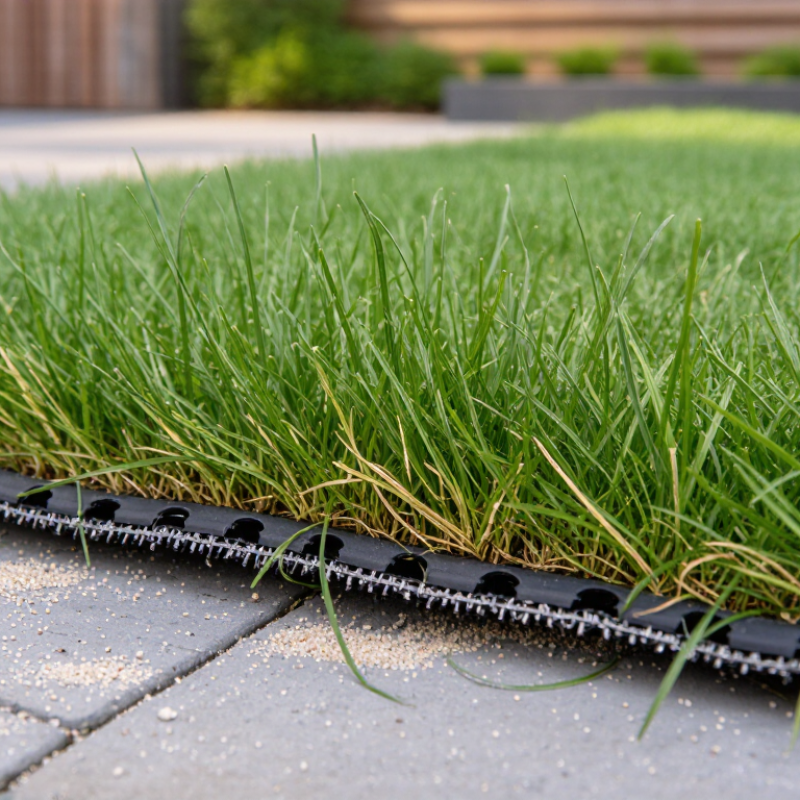
Imitation grass is a manufactured surface designed to look and feel like a lawn. Its visible blades are usually made from polyethylene, polypropylene, or nylon. Polyethylene feels relatively soft and suits many residential areas. Polypropylene is often less expensive, but can flatten more easily under frequent use. Nylon is resilient, though it may feel firmer underfoot. These are general tendencies; actual performance depends on blade shape, density, and product construction.
The backing holds the fibers in place. A primary backing is tufted with the blades, while a secondary coating helps lock them in. Drainage holes allow rain and cleaning water to pass through, but the base beneath the grass matters too. Poorly prepared ground can leave puddles, even when the turf drains well. Details count.
Infill consists of loose material brushed between the blades. Silica sand can help weigh the surface down and support the fibers. Other infills may be chosen for cushioning, temperature, or specific use, but each has trade-offs in feel and upkeep. Without enough infill, blades may lie flat; too much can make the surface hard or uneven. A sample underfoot tells only part of the story. Weather, foot traffic, and maintenance change how a surface performs over time.

Artificial turf is made by tufting synthetic yarn into a backing, much like stitching loops into a thick fabric. The fibers are often polyethylene, polypropylene, or nylon, chosen for different balances of softness, resilience, and wear resistance. They may be shaped or textured to look less uniform. Up close, though, the blades can still look repetitive. It is not simply green carpet.
The backing usually has a second layer that helps hold the yarn in place, plus small drainage holes that let water pass through. Below it, installers prepare a stable subgrade and add compacted crushed stone or gravel. This base gives water a route away from the surface and helps limit dips underfoot. Some projects also use a geotextile fabric to separate soil from aggregate, but site conditions matter. The turf is rolled out, trimmed, joined at seams, and secured around its edges; infill may be added to support the fibers. Small details count. A blocked outlet or uneven base can leave puddles, even when the turf itself drains well. It is easy to underestimate that part. The finished surface may feel firm and tidy, but it still depends on careful preparation and occasional maintenance.
Imitation grass, usually called artificial turf, is not approved by one universal sports standard. A football pitch and a rugby field place different demands on players and the surface beneath them. The distinction matters. A field may look even and green, yet still fail to provide the right grip, cushioning, or ball response.
For football, FIFA Quality and FIFA Quality Pro are testing programmes for artificial turf systems. Depending on the level sought, assessments examine factors such as ball roll, shock absorption, vertical deformation, and resistance to rotational movement. These checks help show whether the installed surface meets defined performance criteria. They do not mean every certified pitch feels identical. In practice, infill depth, weather, and maintenance can change how a ball travels or a player turns.
Rugby uses World Rugby Regulation 22, which sets requirements for artificial playing surfaces intended for the sport. Its testing considers rugby-specific performance and how players interact with the surface during running, contact, and changes of direction. Football certification alone should not be treated as proof of rugby compliance; the relevant test programme must match the intended use. Ask for current test records for the actual field, not just a product sheet. A certificate cannot show how a wet, compacted pitch will feel after years of play.
Imitation grass is a synthetic playing surface made from durable fibers set into a prepared base. For football, FIFA’s 105 × 68 metre reference pitch provides a useful scale: the playing area covers 7,140 square metres. It is a reference, not a universal requirement. Actual field dimensions depend on the competition and site.
At this scale, consistent ball roll and predictable footing matter across the entire surface. A well-designed installation needs a stable, level base, effective drainage, and suitable shock absorption. Seams and high-use zones near goal mouths deserve close inspection. Small flaws can affect play.
Beyond professional football, artificial turf is used at schools, community grounds, indoor facilities, and sites where natural grass struggles with shade or heavy use. It can keep a field available after rain, though drainage still matters. The surface also needs brushing and checks for displaced infill or worn fibers. In warm weather, synthetic turf may become hotter than natural grass. That trade-off is easy to underestimate. A smaller training area can also use imitation grass, but its pile and base should suit the intended activity, not simply resemble a full-size pitch.
| Location or activity | Useful dimension or reference | How imitation grass is used | Practical considerations |
|---|---|---|---|
| Full-size association football (soccer) | 105 × 68 m is a widely used reference pitch size. FIFA’s Laws of the Game allow a general field-of-play range of 90–120 m long by 45–90 m wide; international matches have a narrower range of 100–110 m by 64–75 m. | Artificial turf can provide a playing surface where natural grass is difficult to maintain or where frequent use is expected. | 105 × 68 m is a reference size, not a universal requirement. The selected surface must meet the competition’s applicable rules and performance requirements. |
| Small-sided football and training areas | There is no single worldwide pitch size for all small-sided formats. Dimensions depend on the format, age group, and local rules. | Used for training grounds, community pitches, and compact recreational fields that need regular availability. | Plan the playing area and any safety run-off separately. Confirm the governing body’s requirements before construction. |
| Field hockey | A standard outdoor hockey field of play is 91.4 × 55 m. | Specialist artificial surfaces are commonly used for hockey because the sport requires a consistent, predictable ball-and-stick playing surface. | Hockey surfaces are designed for the sport and should not be assumed to be interchangeable with football or landscaping turf. |
| Tennis courts | A tennis court is 23.77 m long. It is 10.97 m wide for doubles and 8.23 m wide for singles. | Artificial grass is one possible court surface, offering a different ball response and feel from hard courts or clay. | These measurements describe the court lines, not the full space needed for player run-off, fencing, or access. |
| Golf practice and putting areas | There is no fixed standard size for a home or practice putting green; dimensions are shaped by the available site and intended layout. | Short-pile artificial grass can create a practice surface for putting or chipping in gardens and training spaces. | Putting performance depends on the product, installation, base preparation, and maintenance; a practice green is not automatically equivalent to a natural tournament green. |
| Gardens and residential landscaping | Custom-sized to the area being covered; there is no universal standard layout. | Used as a lawn alternative in courtyards, gardens, and other areas where a consistently green appearance is desired. | Consider drainage, heat exposure, intended use, and access for cleaning when planning the installation. |
| Commercial spaces, rooftops, and balconies | Custom-sized to the usable surface; the structural area and edge details determine the finished layout. | Used to add a green-looking finish to terraces, display areas, and other hard-surface spaces. | Check drainage paths, waterproofing, fire and building requirements, and the load capacity of the structure before installation. |
Reading the dimensions: Pitch and court figures refer to the marked playing area unless stated otherwise. Extra space may be needed around the perimeter for run-off, fencing, access, or safety zones.
What Is Imitation Grass and What Is It Used For?
What Lifecycle Factors Matter? Water, Heat, Infill, and Maintenance Data
Imitation grass, also called artificial turf, uses synthetic fibers to create a grass-like surface. It is used in gardens, play areas, sports spaces, and places where natural grass struggles. Its lifecycle impact depends on more than the water it saves. Check how the turf is made, how long it lasts, and what happens when it is replaced. A dry lawn can still become a hot surface. On sunny afternoons, dark fibers may feel uncomfortable under bare feet. Measure surface temperature in the hours people actually use the area.
Water savings vary with climate and use. Compare irrigation records for the existing lawn with the water needed to rinse turf and maintain nearby plants. Infill also matters: sand, rubber, or other materials affect drainage, heat, and eventual disposal. Ask for material details and keep installation records. One detail is easy to overlook: drainage performance can change as debris builds up. Maintenance data helps reveal that.
Tips: Track water use, surface temperature, cleaning, and repairs for a full season. Note the date and weather each time. Measure, don’t guess. A small log may expose patterns, though one season cannot predict every year. Include replacement plans when comparing turf with living grass; the answer is not always obvious.
We are the most reliable and proficient jute goods manufacturer & supplier that helps businesses or individuals with various exportable agricultural commodities biz and jute goods by shipping them worldwide. Our right-time service ensures that whatever color and size of jute product you need, we can make it happen anytime and anywhere! Let’s keep our earth safer to live in!
Important link
Address
Bangladesh Address:
Fair Plaza (9th Floor), Plot : 3C, Section : 01, Mirpur, Dhaka:1216
UK Office:
242 Manor Road, Droylsden, Manchester, M43 6JD, United Kingdom.
Let's Talk
We are the most reliable and proficient jute goods manufacturer & supplier that helps businesses or individuals with various exportable agricultural commodities biz and jute goods by shipping them worldwide. Our right-time service ensures that whatever color and size of jute product you need, we can make it happen anytime and anywhere! Let’s keep our earth safer to live in!
Bangladesh Address:
Fair Plaza (9th Floor), Plot : 3C, Section : 01, Mirpur, Dhaka:1216
UK Office:
242 Manor Road, Droylsden, Manchester, M43 6JD, United Kingdom.