
• Home
  • About
    • jute Bag

      Eco-Chic and Durable – Perfect for Sustainable Living.

      Cashew Nut Bag

      Sustainable jute bag for lasting cashew nut freshness

      Cocoa Bag

      Eco-friendly jute bag for rich cocoa flavor preservation

      Coffee Bag

      Elegant, durable jute bag to keep coffee beans fresh and eco-friendly

      Hazel Nut Bag

      Eco-conscious jute bag for hazelnut freshness and quality

      Shea Nut Bag

      Durable jute bag for fresh, organic shea nuts

      Tote Bag

      Stylish, eco-friendly jute tote for daily essentials

      Wheat Bag

      Sustainable jute bag for optimal wheat freshness

    • Jute Yarn

      Eco-Chic and Durable – Perfect for Sustainable Living.

      Jute Rope

      Sustainable jute bag for lasting cashew nut freshness

      Jute Fabrics

      Eco-friendly jute bag for rich cocoa flavor preservation

      Hessian cloth

      Sustainable Hessian cloth suppliers

  • Products
  • Export Country
  • Blog

Why Choose Barista Instant Coffee for Your Business?

For businesses serving coffee, convenience matters, but cup quality still shapes the customer’s impression. Barista Instant Coffee can offer a practical middle ground: familiar coffee character, quick preparation, and less equipment than a traditional espresso setup. The National Coffee Association’s 2024 National Coffee Data Trends report found that 67% of U.S. adults had consumed coffee the previous day. That is a substantial everyday audience. The International Coffee Organization estimated global consumption at 177.0 million 60-kilogram bags in 2023/24. These figures describe coffee demand overall, not instant coffee sales specifically. Still, they show why reliable service matters across workplaces, hotels, and food-service settings. Speed matters.

For a business, the real value depends on the details: taste consistency, serving time, storage, and cost per cup. A pouch or jar that dissolves cleanly can help staff prepare drinks during a busy breakfast rush, even when counter space is tight. Barista Instant Coffee may also simplify stock planning where machines, maintenance, or trained operators are impractical. But “instant” does not guarantee a barista-quality result. Recipes, water temperature, milk choice, and supplier quality all affect the finished drink. A short tasting trial with staff and customers is more useful than relying on a product description alone. I would not assume every customer prefers it; some will notice the difference from freshly ground coffee. That is worth admitting. The strongest business case is a dependable cup, served quickly, at a cost and quality level that fits the venue.
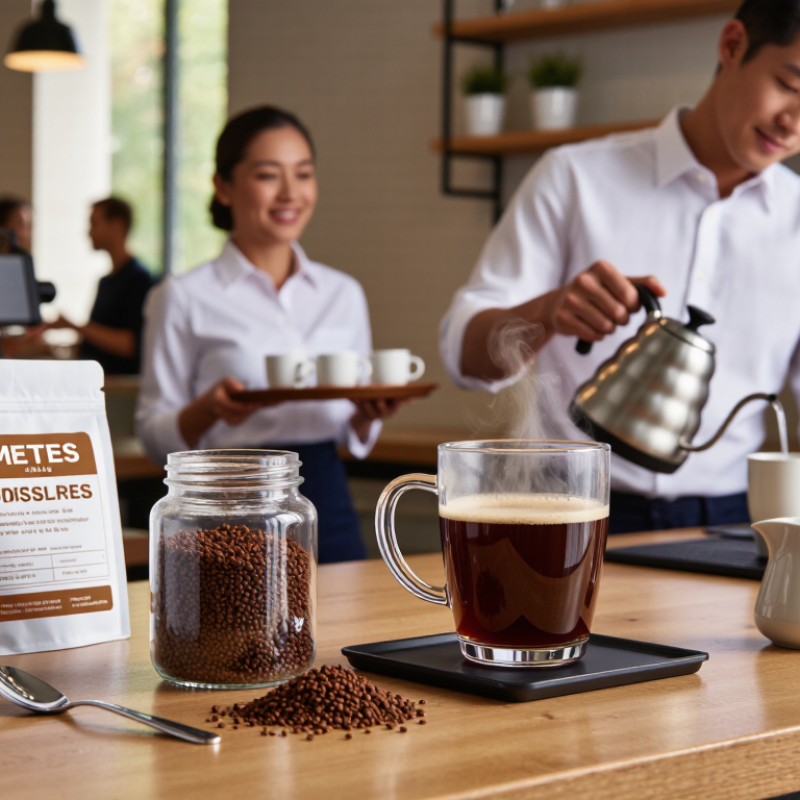
Why Choose Barista Instant Coffee for Your Business?

What Is Barista Instant Coffee?

Barista instant coffee is brewed coffee that has been dried into soluble granules or powder. Add hot water, and it dissolves into a ready-to-serve coffee base. The coffee is brewed before drying, often through spray-drying or freeze-drying. No espresso machine is needed.

The “barista” description usually signals a product designed for café-style drinks, not a separate coffee species. Its flavor and strength are intended to work in drinks such as lattes, mochas, and iced coffees. Some versions dissolve well in cold liquids, while others perform best in hot water. Check the preparation guidance; a few seconds of stirring can change the texture.

For a business, the format can help staff prepare drinks quickly and keep portions consistent during busy periods. A scoop, measured water, and a warmed cup make the process easy to repeat. Small details matter. Still, instant coffee will not reproduce every espresso’s aroma, body, or crema, and “barista-style” does not guarantee a particular quality level. Taste it in the actual recipes you plan to serve, including with your usual milk, before choosing a product.

How Is Barista Instant Coffee Made and Prepared?

Why Choose Barista Instant Coffee for Your Business?

How Is Barista Instant Coffee Made and Prepared?

Barista instant coffee starts with roasted beans, ground and brewed into a concentrated coffee extract. The extract is dried into soluble powder or granules, usually through spray-drying or freeze-drying. Spray-drying uses heated air; freeze-drying removes ice under low pressure. Each method affects aroma, texture, and cost. The International Coffee Organization’s Coffee Report and Outlook (2024) estimated global coffee consumption at 177.0 million 60-kilogram bags in 2023/24. This figure covers all coffee types, not instant alone.

For service, weigh the granules rather than guessing. Add hot water, then stir until no particles remain. A starting point is about two grams per 150 milliliters, adjusted for the coffee and recipe. Use hot, not fiercely boiling, water; excessive heat can make the cup taste harsher. Small details matter. For iced drinks, dissolve the coffee in a little warm water before adding ice and milk. This helps prevent gritty clumps.

In a busy café, pre-measured portions can help staff make drinks more consistently and reduce waste. Instant coffee also needs little equipment, though it will not reproduce every nuance of freshly ground coffee. That trade-off is real. Taste-test each batch with the water and milk your team actually uses, then record the ratio. Recipes sometimes need adjusting after a change in cup size or supplier.

What Business Benefits Does It Offer?

Barista instant coffee can simplify service when a business needs a dependable cup without a full espresso setup. Staff add hot water, stir, and serve; there is no grinder to adjust or coffee filter to replace. That can help offices, meeting rooms, hotel breakfast stations, and mobile counters manage busy periods. Less equipment. Fewer steps. A measured scoop and a marked water line also make portions easier to repeat, though staff still need to check taste and strength.

Demand for coffee is substantial: the National Coffee Association’s 2024 National Coffee Data Trends report found that 67% of U.S. adults drank coffee in the past day. This figure covers coffee overall, not instant coffee specifically, but it signals a broad daily habit businesses can serve. Instant coffee can also reduce storage complexity because it is compact and does not require beans, filters, or a grinder. Compare the cost per served cup, including milk, cups, waste, and staff time. Convenience is useful, but a flat or overly bitter cup can disappoint customers.

Tips: Test two serving strengths with real staff before ordering in bulk. Keep a dry spoon, hot water, and a simple recipe card beside the station. Check freshness after opening; convenience does not prevent flavor loss.

Why Choose Barista Instant Coffee for Your Business?

Fewer preparation steps can help simplify service during busy periods.

This illustrative workflow comparison counts the listed steps: instant coffee (measure, add hot water, stir) and batch drip coffee (measure grounds, prepare filter, add water, brew, serve). Actual workflows vary by equipment and serving method.

Which Businesses and Menu Applications Suit It?

Barista instant coffee can suit businesses where speed, simple equipment, and repeatable portions matter. Small cafés can use it during morning rushes when the espresso queue grows. Hotel breakfast rooms may find it useful beside kettles and self-serve milk. Office kitchens, bakeries, mobile carts, and event caterers can also benefit when counter space or trained staff are limited.

Its menu uses depend on how the coffee dissolves and tastes in the chosen recipe. Serve it as a straightforward hot coffee, or blend it with warm milk for a quick café-style drink. Some formulations work in chilled drinks, too, such as iced coffee with milk over clear cubes. Test the mix before adding it to a menu. Cold water can expose clumps or harsh notes.

Keep the recipe practical. Measure each serving, note the water or milk temperature, and check the flavor during a busy service—not just in a quiet tasting. Speed matters. Instant coffee may not replace espresso where customers expect crema or a freshly pulled shot. That trade-off can be acceptable for breakfast service or meeting rooms, but less so for a specialty coffee bar. Small trials help reveal the difference.

What Should Businesses Consider When Buying and Storing It?

Why Choose Barista Instant Coffee for Your Business?

When buying barista-style instant coffee, test it in the drinks you actually sell. A sample that tastes smooth black may turn sharp in a latte. Check its aroma, strength, and how quickly it dissolves in hot water. For iced drinks, see whether it dissolves without leaving grit. Small tests matter.

Compare the cost per prepared cup, not just the price of each pouch. Ask suppliers about ingredients, pack sizes, lot dates, and recommended use after opening. Choose packaging your team can finish while the coffee stays fresh. A large pack may look economical, but slow turnover can make it a poor fit. That is easy to overlook.

Storage is simple, but not careless. Keep unopened packs in a cool, dry cupboard, away from ovens, sinks, and direct sunlight. After opening, seal the container tightly and use a clean, dry scoop. Steam and damp spoons can cause clumping. Avoid transferring coffee into a clear jar beside a hot espresso machine. Follow the supplier’s storage guidance and rotate stock by date. A half-open pouch can get forgotten during a rush; add a quick closing check to the routine. This habit takes seconds.

Why Choose Barista Instant Coffee for Your Business? — What Should Businesses Consider When Buying and Storing It?
Business Consideration Useful Data or Check Practical Buying or Storage Guidance
Preparation speed Instant coffee dissolves in water, so there is no need to grind or brew coffee grounds for each serving. Assess whether faster preparation could help during busy service periods; follow the product’s directions for serving size and water volume.
Cost per serving Calculate: pack price ÷ estimated number of servings. For example, a 500 g pack makes about 250 servings at a measured 2 g per serving. The 2 g dose is an illustration, not a universal recipe. Test the preferred strength and use the supplier’s recommended dose when estimating costs.
Demand and order quantity Estimate weekly use from expected drinks sold × the measured coffee dose per drink. Compare forecast use with pack size and minimum order quantities. Avoid purchasing more than can be used within the product’s stated shelf life.
Product specification Review the ingredient list, coffee type, pack weight, preparation directions, allergen information, and country-specific label details. Request a specification sheet and sample where available. Confirm that the flavor, strength, and format suit the intended menu.
Consistency and quality Check that the coffee dissolves as directed and that aroma, taste, and appearance are consistent between batches. Use a repeatable measuring method and preparation recipe. Record lot details so a batch can be identified if a quality issue arises.
Unopened shelf life Shelf life varies by product and packaging; the printed best-before date is the relevant reference. Check dates on delivery and rotate stock using first-in, first-out (FIFO). Ask the supplier about remaining shelf life before placing a large order.
Storage after opening Moisture, heat, air, and strong odors can affect dry coffee quality. Keep the pack tightly closed or transfer the coffee to a clean, dry, airtight container. Store it in a cool, dry place away from heat, sunlight, sinks, and odor sources.
Hygiene and handling Wet utensils or hands can introduce moisture and cause powder to clump. Use a clean, completely dry scoop; close the container promptly after use. Follow workplace food-safety procedures and the supplier’s handling instructions.
Packaging and waste Compare pack sizes, resealability, and packaging disposal instructions. Select a pack size that matches usage and storage capacity. Check local recycling guidance because packaging materials and facilities vary.
Supplier reliability Review delivery lead time, order minimums, product documentation, and the supplier’s process for handling quality complaints. Confirm these details before relying on the product for regular service, and keep enough stock to cover typical replenishment time without excessive over-ordering.
Shopping Basket